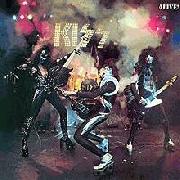
Review Summary: One step forward, two steps back.
In late 1974, Gene Simmons and Paul Stanley were in a conondrum. Their grand design for world domination through rock’n’roll had gotten off to a rather underwhelming start, with KISS’s first album garnering little more than a cult following, even after heavy promotional investment. So the only solution for the two founding fathers of the masked foursome to keep the band from falling off public consciousness was, of course, to release another album.
Hence,
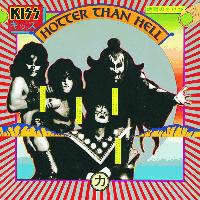
Hotter Than Hell, the band’s second release in the year of 1974. Keeping the same personnel, but changing the recording studio, the group would face a few hardships while completing this record. First and foremost, they were in a strange town, living on hotel rooms; second of all, Los Angeles provided plenty of opportunity for guitarist Ace Frehley and drummer Peter Criss to indulge in their favourite vices, which of course interfered with the recording process as well.
Still, somehow, the album got made; but of course, the short timespan between this album and the debut, combined with the aforementioned problems, would make for a much less consistent final product which, while still good and even innovative in a way, still wasn’t enough to raise much attention from the general public.
The first major difference one will notice when playing this record back-to-back with the previous one is the substantial increase in heaviness. Where the debut treaded rather close to the Rolling Stones, the New York Dolls and other 60’s-influenced bands,
Hotter Than Hell inscribes itself firmly in the field of proto-hard rock, sounding like something Alice Cooper or Ted Nugent may have been writing in the same period. The change is evident from the very first track,
Got To Choose, which begins with a mid-tempo riff, steady pounding bassline and thumping drums, a template which would be all the rage a decade later. Soon the track changes into typical KISS territory, but without the guitar losing any of its edge.
Subsequent tracks follow this same mold – slow-to-midtempo, with heavy guitar riffs – with very few nods to the
Kiss sound. What little references there are to the past end up, ironically, being the standouts, as in the case of
Let Me Go Rock’n’Roll and
Mainline. Both revert to the “amped-up 50’s-rock” sound of the debut, and both are absolutely delightful, managing to largely surpass anything on the already excellent
Kiss. Peter Criss even gets to flex his lead-vocal chops on the latter, reprising the role in
Strange Ways, with dignified results.
The other clear standout is
Goin’ Blind, a track that actually predates KISS, having originally been recorded and released by Gene Simmons’ college band, Bullfrog Bheer. Here, the reasons for the distinction lie in the fact that it’s a ballad (something unheard-of so far from KISS) and in its hilarious lyrics (
”there is nothing more for you and I/I’m 93, you’re 16/and I think I’m going blind”). While its subject matter would hardly fly in today’s PG-obsessed world, it is undoubtedly original and absolutely hilarious. I wish I could see the faces of people in 1the late 60’s and early 70’s when they listened to this song! It must have been priceless!
So, as established, the standouts in this one are even better than those on the debut. Would that the remaining album were so good. You see, the rest of the songs sound somewhat inferior to those on
Kiss, which may or may not have been a product of the album’s rushed execution. While the choruses remain big, dumb and braindead (the first track’s chorus goes
”woo-hoo-hoo/got to choose” while the second’s goes
”parasite, baby/parasite, aah”), but the music itself lacks that spark that made the debut such a pleasant listen. Most of the tempos plod, and while riffing and soloing are mostly good, this album still manages to have something unseen in the debut: bad songs. Such is the case with the god-awful
Watchin’ You, while tracks like
Hotter Than Hell, All The Way, Parasite or
Comin’ Home mostly rate in the “nondescript” category. On the other hand,
Got To Choose and the hypnotic, almost progressive
Strange Days provide solid backup, and when added to some of the previously mentioned songs, raise this album slightly above the line of water.
Still, it’s easy to see why
Hotter Than Hell didn’t bring KISS the success they hoped for. In it, the band follows the old adage of taking “one step forward, two steps back”. The step forward represented by the increase in heaviness is counterbalanced by the decrease in songwriting quality and overall album interest. Therefore, it would take KISS until the following year to really leave a mark in the hard rock scene. And what a mark that would be…
Recommended Tracks
Goin’ Blind
Let Me Go Rock’n’Roll
Mainline