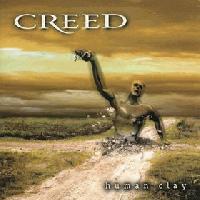
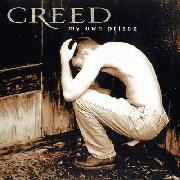
Review Summary: A happier album succeeding a dark moment, but at the same time a sloppier album succeeding Creed's best work.
Creed always were, and still are a popular band. Since its debut album My Own Prison, the band has always met with high record sales, heavy radio airplay and high positions in charts, by both albums and singles.
But Human Clay was, by far, their breakthrough album. The album debuted no. 1 on the Billboard 200 charts, sold wildly thanks to hit singles "Higher" and "With Arms Wide Open", became their best-selling album (11x platinum in the US), and went on to launch the already good sales of its predecessor.
Besides that, actually "breakthrough album" is referred exclusively to the commercial side; because this is not their best album, and it features a bunch of mistakes which weren't present in My Own Prison (and, if they really were present on that, it was much less notorious and minimal in proportion, maybe title track or What's This Life For (in spite of the title track having a high level), but not more than that), that unfortunately persisted in later releases (but there's still a hope to "Full Circle" not feature these mistakes, in a minimal or least proportion. "Overcome" is a good start kick to that hope). Those mistakes are mainly three.
The first and biggest mistake can be summarized in one adjective: FORMULAIC. An standard song structure throghout the WHOLE album, based on clean and boring arpeggios on intro and verse, loud distorted guitars on the choruses and bridge, in where it may suffer just very small variations, and no guitar solos, with the "exception" of "With Arms Wide Open" where we have a pretty brightless one. Overall, riffs with low imagination (even if techncially they may be good), the same "loud-quiet-loud" dynamics in a bad ripoff of
Nirvana and
Pixies, because those groups were kind of pioneers of those dynamics, and were much earlier of the times in which those dynamics became an absolute cliché thanks to, for example,
Seether,
Staind and its infinite power ballads, and this band, Creed.
The second mistake goes given by hand to the first one: the LENGTH of the songs and the album overall. The album features 11 tracks, and a total length of 56 min. 18 sec., that means an average length of 5 min. 7 sec. per song, length which doesn't fit in tracks with repetitive arpeggios alternated with loud choruses accompanied by charmless distortion, and no guitar solos to speed up the rhythm and excitement of songs (which lack those two factors and in where an, at least, interesting solo would fit very well), and makes the songs slower, and more tedious.
Finally, the third mistake, which appears in the whole career (but in this release more notoriously than the rest), probably the least important in this record, and where a big mass of public against Creed criticizes as maybe the most notorious and worst mistake (frequently exagerated by anti-Creed people), is STAPP'S VOCAL WORK, which is seen as too much similar to
Pearl Jam's Eddie Vedder, which is clearly notorious, but at the same time it isn't that hyperbolic and absurd mimic that a lot of people claim.
In spite of those main mistakes or negative points, this album also has their positive points, as the lyrics, where Scott Stapp maybe doesn't make a splendid work (and maybe not as strong as MOP), but certainly they have their depth and have good messages, and inside the topic of lyrics (not only referred to this single album, but to the band's work in general), he and the band shows themselves very brave when expressing their religious beliefs (even if in a hidden or sometimes inexplicit way) with no daddling or pride. There's no bad point at being sincere and expressive on religious matter, mostly when those are really important or influent for the songwriter, maybe being that the case of Stapp. And the album has its highlights too: Say I, Are You Ready? and With Arms Wide Open, which are pretty decent and good tracks, and in the case of the last one, in spite of being infamous because of being over-exposed and overplayed, it sure is a beautiful and inspired track, which positively settles a tender and cheerful mood.
It's common in the world of rock that, in moments of maximum turmoil and darkness, the best albums are released, examples of that are
Alice in Chains's Dirt and Creed's My Own Prison; and it's also very common that an album isn't capable to succeed a band's "great work" with an equal level album or best (in sales, quality or both). Curiously, with Human Clay, all that happens with Creed: the first one already mentioned, and in the second, despite being champion in sales, the album can't match its predecessor. But , in fact, not necessarily because Stapp wasn't in turmoil or darkness and consequently the album wasn't dark but in fact happy, but by the fact that Human Clay isn't anything more or less than AVERAGE.