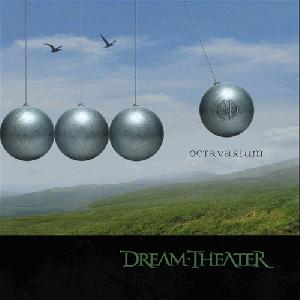
Review Summary: Trapped inside its own Octavarium, Dream Theater's eighth fails to do anything but annoy, pointlessly repeat and grab influences from anything with almost zero regard for making them sound either listenable or unique.
As I have probed further into Dream Theater's eighth studio album,
Octavarium, and listened to more and more progressive metal, I have been unable to deny that what makes the best progressive metal great is missing from it; it seems the band has run out of innovative ideas and squandered their musical integrity. The root of all evil, so to speak, on
Octavarium is that it doesn't bother trying to develop its ideas, instead letting the
exact same idea run on repeat when it was never interesting, or simply taking a bunch of influences without even trying to make them sound either interesting or like their own work.
The most demonstrative example is the sixth song,
Never Enough - absolutely horrific and without a shred of Dream Theater in it. There are no riffs to speak of, Jordan Rudess is relentlessly predictable with his keyboard flashes (what happened since one of prog's best keyboard performances on
Six Degrees?), the song structure goes absolutely nowhere, and the
Muse style electronic effects are completely out of place with the subject matter. Mike Portnoy's lyrics take an unapologetic swing at DT fans that are never satisfied and just won't quit bashing their material, but because the song is so devoid of cohesion and innovation,
Never Enough reads out more like a seven-minute rant than a song. James LaBrie's vocal performance doesn't help either: the verses are sung behind the mix in a ridiculously over-the-top whiny, aimless manner with no melody behind them, while the chorus falls embarrassingly flat and cannot carry the song's main point - that these people would actually appreciate his talent when Portnoy walked out of Dream Theater (though such incident was far away at this time). Absolutely nothing here can even be considered Dream Theater - are we sure this album didn't accidentally get switched with
Elements of Persuasion and the initial leak wasn't the real
Octavarium?
The metallic compositions are the closest to Dream Theater's signature style of music and are definitely
Octavarium's best outings.
Panic Attack still shows shades of the band's smart, original thinking with intelligent use of heartbeat effects to instill a deep panic in the listener fitting of the song's relentless intensity from start to finish. John Petrucci impresses on this song with one of his trademark speedy sweeps and some absolutely vicious riffs that stand out as not just excellent for this CD, but excellent. LaBrie does well here at not being melodramatic and matches the music and its lyrical theme of a panic attack (obvious, heh). Even through these high points, the songs themselves are predictably structured and make for a tedious listen.
Octavarium is a conceptual album about cycles, but that doesn't mean it's possible to just write the same thing the same way 100 times and call it a "cycle". All songs have traditional structures, often basic verse-chorus formats, and there is no attempt to make the songs build or progress between these points. The buildup to the choruses is so easy to spot that the band might well have put up a sign that says
CHORUS APPROACHING IN 6.24553 SECONDS; the narrator seems like he
knows what is happening and just doesn't do anything about it, rather than trying to fight against the Octavarium cycle. The chorus of
These Walls comes after the same musical motif and sounds
exactly the same each time, which means the piece covers very little musical or thematic terrain; instead of going around in a circle and coming back to the same spot again, it sounds more like the narrator discovered a time machine and pressed a button to turn back time to where he was.
The intent of Dream Theater with
Octavarium, given its distinctly more accessible approach, was to explore more subtle, softer sounds, which makes it all the more surprising how forgettable these are.
The Answer Lies Within is extremely mellow, its atmospheric effects and strings are quite pretty and James does sing quite well - but again, it
doesn't feel like Dream Theater is playing this. Sacrificed Sons utilizes several distinct moods and sections to portray the story of 9/11 making its way through American consciousness, and in comparison this is much more impressive, with a fantastic closing drum solo and richly layered chorus – yet the syndrome strikes again in that much of the classical piano touches seem lifted right from
Redemption who was recording their second album in the same year! The intro piano melody could have even come right off the floor of Mr. van Dyk.
The title track takes all these problems to absurd extremes: the eighth song composed of five movements, 3x8 minutes long, a recap of all eight songs’ themes, and liberal use of musical motifs based off 5 and 8…all of which doesn’t mean a thing! Just about the entire composition feels like a generic prog-rock gimmick, built for the sake of lasting
twenty-four minutes. The sections feel very awkwardly stitched together, with movement 1 shifting gears into movement 2 without warning and with an obvious intent to just drop the movements together: the drum kit sounds different in movement 2 than in movement 1! No metal appears at all until close to the 14-minute mark, and none of the lush prog-rock jams or acoustic strumming to this point makes any impact or sounds particularly distinctive or original. The drama only finally starts picking up around 16 minutes, but is quickly broken up with more pointless shredding at random intervals in periods of eight (there it is again!) The climax finally arrives and is definitely the best part of the piece, but by now it's been 19 minutes and the melodies aren’t even new at all – just grander and with strings added.
Octavarium finishes with quite a nice, reflective guitar solo that does, at last, sound like John Petrucci and nobody else, and then moves into a grand finish and fades out into a reprise of the album opening. Long epics like this are very difficult to write, but bands that do try them often tend to succeed more often than expected; yet for an established band like Dream Theater, who has written enough epics to have the subject down, this is about as poor an effort as can possibly be expected.
For all Dream Theater's intent to be more concise, it is most ironic that the biggest problem with
Octavarium is its lack of ideas and inspiration, and even its messy, unfocused arrangements. For all their intent to be more subtle, it is most ironic that
Octavarium does not hesitate to beat the listener over the head with its frequent monotony. Lastly, for all DT's intent to bring their music to a wider audience, it is most ironic that
Octavarium contains much of their worst, most derivative, and least palatable music of their career - and only bare flashes of their best cannot lift this beyond its rating.