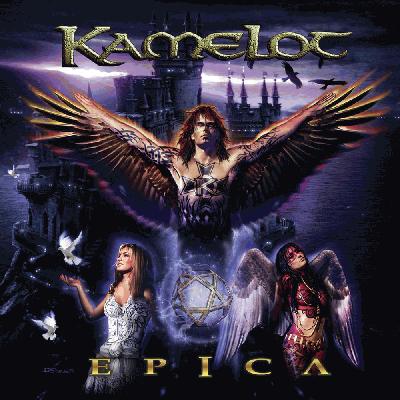
Review Summary: Although not as strong as the follow up, Epica is nonetheless an amazing power metal album that showcases Kamelot near the top of their game.
A wager is made in the heavens: if an exiled angel (Mephisto) can claim the soul of God’s favorite man, then he will be able to reenter heaven. But if he cannot, then he will be eternally condemned to hell. After leaving all he’s ever known to search for truth, Ariel (the object of the bet) is introduced to Mephisto, who offers him every possible worldly desire in exchange for his soul after death. Ariel makes a compromise, saying that if at any point he’s so content that he wishes to linger there forever, then Mephisto can have his soul.
Thus is the basis for
Epica, part one of Kamelot’s two-part concept album based on Johann Wolfgang von Goethe's Faust story. These two albums make what is most likely the power metal powerhouse’s finest hour (or rather, two hours).
Unlike the Dragonforce’s of the power metal world, Kamelot puts dramatic and operatic vocals over hard-hitting metallic guitars, drums and bass. The result is epic, melodic and powerful songs that are not only better than a lot of power metal, but also don’t come off nearly as cheesy as most.
The musicianship present is more than solid. Guitarist Thomas Youngblood delivers plenty of great riffs throughout the album, never letting things get boring throughout. He can also solo quite well, and displays said skill in the first two songs (and later on as well). Even though the production drowns out the bass while Youngblood is playing, it is audible in the softer moments of the album and there are some great basslines present here. Drummer Casey Grillo also showcases substantial talent in the first two songs, laying down a great double bass pattern behind Youngblood’s rapid fire riffing. Grillo is never hyper-technical throughout the album, but simply backs the rest of the band, and does so quite well.
Even with the strong musicianship on display here, it’s Roy Khan’s voice that elevates Kamelot to a significantly higher level. His powerful, amazing and (to my knowledge) unique voice displays not only great range, but also the ability to hold notes almost perfectly. This is all no real surprise when you consider the fact that Khan has had classical training, and this also (helps) explain why his vocal style brings to mind opera vocal styles. The man truly towers above his band mates in terms of sheer talent, which is why I’ve devoted a full paragraph to him.
As mentioned before,
Epica is a concept album. Although the lyrics don’t always make it clear what going on in the story, reading them a couple times will certainly help (and the wikipedia article(s) for both albums explains them perfectly). Although
The Black Halo is musically superior,
Epica does a slightly better job with the concept – or perhaps just with the interludes. All four of the interludes are interesting to listen to, and help
Epica flow almost perfectly as a cohesive body of work.
So far all I’ve done is praise this album, and it’s a bit hard to come up with real negatives. There is a small sense of monotony when hearing the album for the first time, but this soon goes away as one learns the songs.
Epica’s two ballads, “Wander” and On The Coldest Winter Night”, are placed on the tracklist so as to help break this monotony, and “III Ways to Epica” stands out because it showcases everything good about the band in six glorious minutes. The interludes also help this, creating moments of (delightful) distraction from the excellent songs. An aroma of cheese might float to some listeners' noses during the album, but the “epic” and dramatic nature of the songs still works so well that the songs are awesome (as in “awe inspiring”, the word’s true definition). The only real problem with
Epica is that it is consistently great, but not consistently amazing like
The Black Halo is.
Most power metal bands seem content to write extremely cheesy songs usually delivered in an equally cheesy manner. Songs about Lord of the Rings, dragons, wizards and mythical lands seem to permeate the genre (or at least what this reviewer has yet to come across). I won’t say that Kamelot has come to save the genre, but they certainly stand as a force to be reckoned with.
Epica is a strong testament to this - epic, heavy, melodic and powerful throughout most of its duration, it’s an album every fan of the genre should own (unless you don’t have
The Black Halo yet).
Final Rating: 4.2/5
Recommended Tracks
Center of the Universe
Wander
Lost & Damned
III Ways to Epica