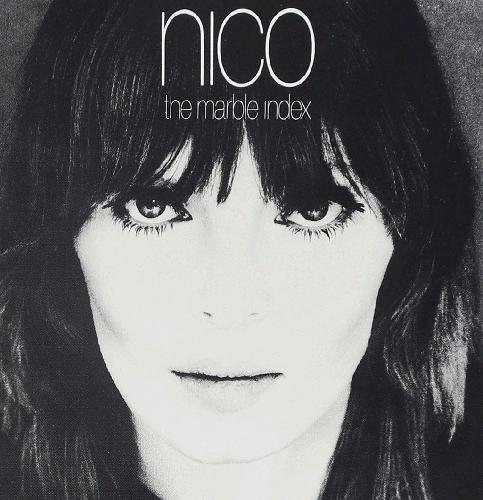
Two times, now. I've started this review two times, just listening to the album like usual, letting myself go on as naturally as I can. At some point in the writing process, the music becomes ancillary, like the clickity-clack of keys. Not so with this one. The problem is I'm still not comfortable with The Marble Index and I'm not completely sure why.
Well, actually I know why.
It's like the sound of someone rhythmically tapping their fingers on a metal table in a cavernous room. You and this other person are all alone in this room, let's say it's a cafeteria, linoleum floors and mystery meat stains. And the only thing you can do is stare one another down. Alone in awkward silence, incensed by the stench of second-rate grub. There is a certain ambiance about this album, the empty cafeteria. However, there is another quality, a quality absolutely contrary to the idea of ambiance, that agitating other person. My point is I can't concentrate a lick when I listen to this album.
And is that a good thing or a bad thing? Neither. Maybe both. I'd rather not rate this album at all. In part, I'm giving it a one star because not enough albums here get one star. But the main reason is it didn't click with me. I don't hate it, I don't like it, I'm not indifferent to it. Don't ask me to explain. Let's move on.
It would be wrong to call The Marble Index a complete three-sixty from Nico's solo debut, Chelsea Girl. After all, both are drenched in melancholy and introspection. The only difference is each executes the drear in a different manner. Chelsea Girl might be most notable for its big name contributors (the likes of Dylan, Tim Buckley and her Velvets cohorts get credit among others) but underneath the bylines are decent, somewhat threadbare, baroque folk songs sung adeptly in Nico's unmistakable style. The Marble Index retains only John Cale from the last list of associates. It appropriates the dour mood to boot. It abandons those song writer folky louts and gets on down with its avant-garde self.
John Cale's classical training and his work with LaMonte Young and the Dream Syndicate are the key starting points here. Set your engines to pretentious. While Nico's debut courted accessibility, The Marble Index exercises any trace of that aesthetic right from the opening "Prelude." Cale's arrangements attempt to maneuver Nico's lyrical stream-of-consciousness; structure isn't in the plan, the only constant, the ubiquitous viola weaving in and out from one track to another and a good old fashion drone. Nico's words often seem to mock a chorus-verse foundation, and though she's far from a notably remarkable wordsmith, the repetition does seem to drive home some point. Whatever that point is.
Take "Frozen Warnings" for example. It starts out barren, Nico intonating, "Friar hermit stumbles over/The cloudy borderline/Frozen warnings close to mine/Close to the frozen borderline." Cale's trademark drone gradually expands, twinkling and gleaming like the sun on Icelandic shores. And that's about it. Sure, it doesn't amount to much in words.
But "Frozen Warnings" is only one model of the Marble Index Nico. Compare the naked coolness of "Frozen Warnings" with the alternative, tracks like "Facing the Wind" and the album closer, "Evening of Light." The latter is an album highlight, a somewhat frightening and grotesque statement that is fairly memorable. It extends itself from "Frozen Warnings," maintaining the same shining qualities at first, the only difference, Nico's chants. But as the glimmering drone grows louder, Cale spurts out jagged stabs, dissonant and contrary to said drone. By the end, it's all squeals and distorted jabs.
"Facing the Wind" comes from a similar territory and features what almost resembles a piano melody. Beyond that is what sounds like a prepared piano piece chunking and clunking percussively as Nico declares, "It's holding me against my will/And doesn't leave me still." On a couple tracks, Nico gets in the mix on the harmonium. It's most prominent on "Ari's Song," an ode to her son. I'm not quite sure what's harder to imagine, Nico the mad artist or Nico the parent.
The Marble Index is a direct statement that clocks in at just over 37 minutes. Still, I can't think of an album that proposed a more difficult or tedious first listen. You know, we get the benefit of years of hindsight with albums from other generations. This album earned its share of write-ups; it's coming up on 30 years old now and it's a hard album to ignore. I really didn't pay any heed. I'd like to rationalize the reasons why I don't burn this album in its place with a Bic lighter but there's no point because I don't really hate it. I get a feeling when I know I blew some cash on a sour album. I didn't get that feeling with this one. It was compelling, but I didn't like it. More than anything, The Marble Index sounds really important. But I can't find it in me to give a big shit about that.
I don't think I'll ever get to the point where I'll be sitting around one lazy afternoon and think, "You know, I could sure go for some Marble Index right abouts now!" This album doesn't deserve one star but it got one. I'm going to highly recommend this one, not because I love it to death but because it provided me an interesting listening experience. That's all I can demand for from any album.
_______________________
Released: 1969; Elektra
Re-released: 1991; Elektra
*Bonus tracks