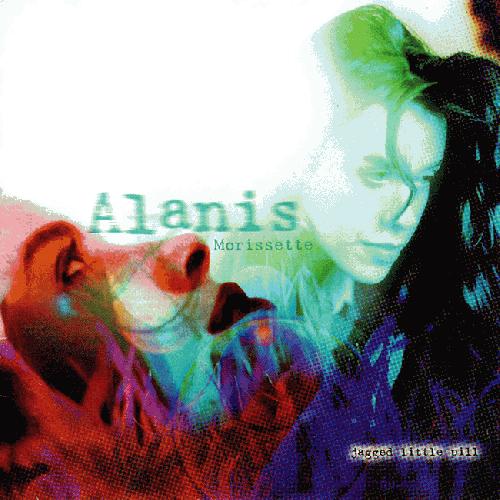
Alanis Morissette had already released two albums in 1991 and 1992 titled Alanis and Now Is The Time respectively. However, her career appeared to be headed more along acting lines, as she was a semi-regular in the Nickelodeon series You Can't Do That On Television. Her ambitions lay elsewhere, and she moved to Los Angeles where she met producer Glenn Ballard, who had previously worked with Michael Jackson amongst others. Ballard was a major force on the album, he co-wrote and provided guitar on all of the tracks as well as producing the record.
A lot of guest musicians feature, including Dave Navarro and Flea, both from Red Hot Chili Peppers.
Jagged Little Pill is widely regarded as a classic Nineties album, and propelled Morissette to the status of a female role model worldwide. One of the most-praised aspects of this album is the lyrics, and by and large these do not disappoint. Morissette has a very interesting way with words, and this is shown particularly well on tracks such as "You Oughta Know" and "Hand In My Pocket." A lot of the album is very angst-driven, and Morissette's voice suits the raw emotion her lyrics portray. However, often her verses have almost too many words in them, and as she tries to cram all she wants to say into a four-minute track the result can sound a little clumsy. Fortunately, this is not always the case, and she does produce some gems such as "took me out to wine, dine, 69 me but didn't hear a damn word I said" on "Right Through You."
The actual vocals on the record are very distinctive, Morissette possesses one of the most recognisable voices in the business, but it is by no means an obviously talented voice. In fact, her singing can often be grating and jarring. In many songs this adds to the effect, and in some of her slower tracks she does manage to tone it down, but every now and then the song requires more vocal ability than Morissette appeared to have at her disposal at the time of recording.
The use of many guest musicians helps to save the instrumental parts from some of the dreariness often found on solo artist recordings, a good example of this being on "You Oughta Know," where Flea and Dave Navarro provide good guitar and basslines. The overuse of harmonica solos is quite irritating however, and you can't really listen to the record in order to enjoy the musicianship.
The real strength of this album is its vocal melodies. All the songs are catchy, accessible and often very well written and manage to avoid cliched and tacky MOR nonsense on the whole. Whatever your mood, there will be a song on here that you can sing along to with considerable enjoyment, if not good musical results. Morissette manages to capture many common emotions that most people couldn't put into words so eloquently as she does, and much of the time she does appear to sing with an appealingly genuine quality.
There is always a lot of disagreement about what the standout tracks on this album are, obvious ones such as "You Oughta Know" and "All I Really Want" appear frequently, but other songs such as "Ironic" and "Hand In My Pocket" have their relative merits debated frequently.
My personal favourites are "Right Through You," "Hand In My Pocket," and "Forgiven," but almost every track has a devoted following. The quality of the songs does decrease a little towards the end of the album, but a lot of it does play as a greatest hits collection, which is to its credit.
Whilst this album is ten years old now, it has lost none of its potency and can be enjoyed just as much today as it could have been when it was first released. It may not be for everyone, but it is definitely worth checking out, especially if you are only familiar with "Ironic," which is not one of the best tracks on the album, in my opinion.


 ).
). 
