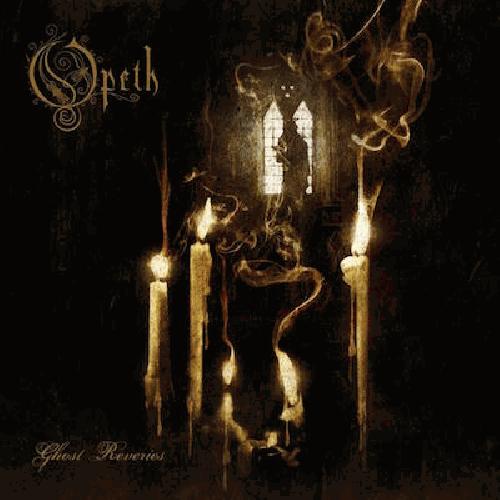
Review Summary: Another excellent Opeth album that plays to convention a little more than fans accustomed to the band's exploratory nature will be accustomed to. However, there are enough changes to make this a worthwhile listen. Plus it's Opeth, come on.
Opeth are a band that few on this site are unfamiliar with. It’s hard to explain what makes them so appealing and interesting to fans of progressive and metal music, but in my opinion, it’s the way they combine a definite feeling of mood with catchy music, incredible technical skill, and enough changes in tempo, time signature and texture to mix things up a little, but not too incongruously. With the addition of a permanent keyboardist to their lineup for this release, some were worried that the very prog-rock direction taken on Damnation would overwhelm the heavier part of Opeth’s sound. Matters were not helped by the band’s move to Roadrunner, a major label that has its fair share of good artists (Dream Theater, Killswitch Engage, Stone Sour) and a disproportionate number of bad ones (Nickelback, Madina Lake, Trivium, Within Temptation, CKY, Atreyu). With these factors in play, how did the band change, and more importantly, how was the end product?
To generalize in the extreme, this CD is unfortunately fairly regressive. Perhaps the massive change-up in sound that Damnation gave us made Opeth fans a little too expectant for a big change. But really, this CD is virtually Blackwater Park II. The band utilizes several tried-and-tested formulas that made their fifth studio album such a success. The album opener that starts gentle and eerie, then explodes into a heavy 3/4 time riff, only to level out into soft melodic acoustic passages partway through? “Ghost of Perdition” is a somewhat lackluster rewrite of “The Leper Affinity,” but there are some differences, and largely these carry over to the rest of the album as well. For instance, the soft sections include a little more variation than the haunting acoustic riffs and occasional bass underbelly that we saw on Blackwater Park. A Tool-like rhythmic section propels vocalist Akerfeldt’s lyrics on the first soft break on “Ghost of Perdition,” and the beautiful, touching album highlight “Atonement” features great Eastern guitar lines amid soft wandering piano lines. In general there is far more range in sound than the two polar opposites (heavy and soft) that we saw before. There are classic rock sections on “The Baying of the Hounds,” tribal sounding sections on many songs, and a hazy mysterious middle ground that characterizes the entire album.
This distinctive mood definitely helps give the album its own identity. Blackwater Park had a much darker, hopeless vibe, whereas this release has a feeling of dreamlike exploration and journeying. If their 2000 masterpiece took place during dusk and twilight, this album seems set in misty morning. This dynamic shift is good, because the band tries to counteract this by rewriting many of the songs almost verbatim from Blackwater Park. “Atonement” takes the place of “Harvest,” “The Grand Conjuration” is much like the title track of the earlier album, and “Baying of the Hounds” has its fair share of similarities to “The Funeral Portrait.” The fact that both albums have 8 tracks does not help especially. Although the songs are not exactly the same, there are too many parallels to ignore, and thus Ghost Reveries feels like a revisit of the older album.
However, if we could eliminate one of the albums entirely so that no accusations of plagiarism could be made, Ghost Reveries would come out on top. More than before, the songs deserve their extended song lengths, and passages drag less and less. The band may be writing the same songs as before, but their skill with layering, arrangement and texture rival those of Tool or Alice in Chains. This is most visible on the quieter numbers, such as “Isolation Years” and “Hours of Wealth,” but “The Grand Conjuration” is a good example of the band’s ability to give meaning to brutality. The band’s compositional skills are assisted by the addition of their new keyboardist. Sadly he does not have the same aptitude for heaviness as his fellow musicians (particularly Akerfeldt, whose vocal abilities have never been more versatile). “Beneath the Mire” and “The Grand Conjuration” both suffer from a slightly cheesy overuse of his talents. Unsurprisingly, he shows much more skill during songs like “Atonement,” giving them the same melancholy spirit that filled Damnation. He shows the most skill as an ordinary pianist, overstepping his boundaries when synths or heavy parts are required. The rest of the band has remained the same on a technical level. I can’t recall any bass, and the guitars seem to solo quite a bit less than before. Martin Lopez’ last stand on the drums, however, is his best album performance so far (I haven’t heard anything before Blackwater Park so that may not be the most credible statement ever). The drums here are truly great, made even more meaningful by Lopez’ later departure.
Although the mood of the album is much better, and the music seems much more fluid and less “riff A, chorus B, solo,” there is still way too much filler. A band like Opeth cannot be burdened to isolate their filler in single “tracks” like other bands might, so the band pads every song to at least 5 minutes by repeating riffs. At least half of the running time “The Grand Conjuration” is occupied by variations of the same riff. Similarly, “Harlequin Forest” fills up its last two minutes with an overlong coda that sees little variation. “Beneath the Mire” is the only track that might be called filler; although the several all-soft and generally shorter numbers are easy to dismiss, their beauty gives them staying power. Opeth have always allowed ideas to breathe, but there aren’t enough ideas and they breathe for too long. The result is a disc padded by at least 5 minutes simply by repeating sections, and even more with trite conventions that we have heard before.
No Opeth review can go without giving their frontman, Akerfeldt, a mention. His lyrics are just as haunting and powerful as before. Although the typical concept album involving love, death and vengeance is to be expected at this point, he creates incredibly vivid stories through a great grasp of language and how certain words can trigger emotional response. Not surprisingly, his excellent lyrical passages are most effective when delivered in his clean voice, which has improved quite a bit. Even better is that there is no longer the division between quiet frailness and Cookie Monster screaming. He pulls off some strong but not guttural rock vocals from time to time on songs like “Baying of the Hounds” and “Reverie,” which give the band some more diversity. The only complaint in the vocal department is that he seems to have grown just as lazy as the rest of the band in terms of writing vocal lines. “The Grand Conjuration” uses the exact same vocal “melody” as the repetitive riff of the song, and in general his lines seem less new and fresh as they once did. Remember the verses of “Windowpane” or “Harvest?” What happened to clever, original ideas like that? His voice is as good as ever, but it would be nice to see it used on some truly stunning tunes.
Despite the feeling of been there, done that, Opeth has improved in many ways on their formula and given us a CD that gives us much more to think about than their last few releases. Hopefully with the upcoming Watershed they can forsake formula entirely and create the legacy of innovation that their fans attribute to them. As it is, this is a fairly standard part of Opeth’s catalogue that, for all that implies, still belongs in a Top 10 of the year list, if not a Top 5.
ADDENDUM: And I know how popular “jazzy” is to describe any soft progressive part in metal music, but give it a rest, guys.