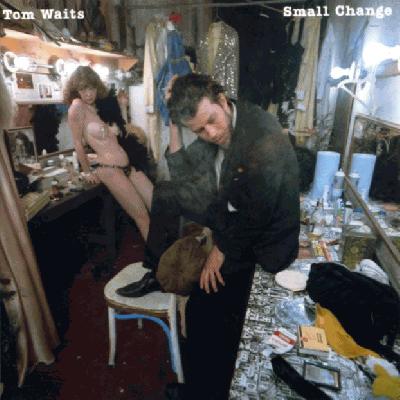
Tom Waits - Small Change
The greatest lyricists evoke images within the listeners mind, painting vivid pictures that speak volumes beyond mere words. The rich history of folk music all around the world and the everlasting strength of songsmiths such as Bob Dylan and Leonard Cohen show the fascination people have with strong imagery in song, and the stories it can tell. Tom Waits is one of the few musical artists of the 20th century who has complete control over this.
A complete oddity on the musical landscape, Mr. Waits has been releasing albums since the early 70's and has over 20 studio album recordings under his belt. Starting off playing jazz tinged piano/guitar based folk music with lyrics telling stories of seedy urban life on the bar scene amongst love ballads on albums such as
Closing Time and
The Heart Of Saturday Night, his music gradually started taking more experimental turns musically painting surrealist soundscapes of purely demented, cartoonish evil on more contemporary albums such as
Bone Machine &
Blood Money. Not that Waits could ever be pigeonholed in such a way musically, the only things that have been consistent about his style is his ability to make magic out of words and to turn people off with his voice in the process. Guttural and throaty, since his early albums his voice has been described as turning to whiskey and gin soaked gravel after a truck just parked over it. Just like peers Bob Dylan & Leonard Cohen, Waits has had to rely almost entirely on his lyrical abilities to receive any praise but quite unlike both he dwells in a much stranger place creatively with his music.
Small Change is his third studio album, and a solid introduction to his work.
The majority of songs on this album are ballads.
Tom Traubert's Blues (Four Sheets To The Wind in Copehagen), Jitterbug Boy, I Wish I Was In New Orleans, The Piano Has Been Drinking (Not Me), Invitation To The Blues, Bad Liver & A Broken Heart, and
I Can't Wait To Get Off Work are all Tom sitting behind a piano singing, which means two things. The first is that this is one of the least experimental of his works musically, if you want an album that is more consistently representative of this side of him try
Swordfishtrombones or
Rain Dogs. The second is that because this album is almost in it's entirety a man who cannot sing alone with his piano, he is at his rawest lyrically with his heart on his sleeve. Some of the most strong lyrics of Waits career are crafted in these few songs, from the beautiful descriptions of a broken-hearted man lost amongst strangers in a foreign country in
Tom Traubert's Blues (Four Sheets To The Wind in Copehagen) to falling in love with a woman who is only going to bring emotional baggage into his life in
Invitation To The Blues these are very strong songs lyrically. Other ballads such as
The Piano Has Been Drinking and
I Can't Wait To Get Off Work still dwell in a sad, melancholic beauty but are slightly more humorous in approach, whilst the former deals with the surrealistic imagery of a drunkard blaming everything but himself for his miserable life whilst Waits slurs badly the latter deals with a man working 9-5 for his girl in a great little song that uses a lot of funny, quotable lines.
Thought predominately ballads,
Small Change hints at the creative insanity to come in Waits career with the few songs that branch out musically.
Step Right Up is an upbeat swing number with a smooth walking bassline, fast jazz drumming and trumpets, Tom playing the role of Auctioneer rapidly firing out lyrics in a humorous parody of the world of salesmen. It is perhaps the single best vocal delivery of his career, proving his voice does have a unique, charming niche which often gives the music much character it would be lacking without it.
Pasties & A G-string is a tribute to the ladies of burlesque, led by some tom-toms banging away it is purely percussion led and has some of the funniest Waits lines he has ever written (
crawling on her belly/shaking like jelly/i'm getting harder then chinese algebra!). The title track is perhaps the highlight here though,
Small Change is an aggressively told story set to the score of a lone saxophone. Waits spits out lyrics about a violent street hustler who gets what's coming to him (
Small Change got rained on with his own .38) with some lyrics that are strong, metaphorical and venomous all at once. (
And the whores hike up their skirts and fish for drug-store prophylactics/With their mouths cut just like razor blades and their eyes are like stilettos/And her radiator's steaming and her teeth are in a wreck, and nah, she won't let you kiss her, but what the hell do you expect?). It is a spine-chilling moment as Waits paints this sharp and depressing tale in the listeners mind whilst a lone saxophone adds a surrealist allure, for all it's simplicity it is a musically perfect moment.
Small Change as an album feels inconsistent at first, as it is a spattering of avant-garde musical experimentation sandwiched few and far in between several conventional piano ballads. However, over time it comes together and you don't notice this as each track has one thing in common; solid songwriting. Lyrically it is extremely strong, and musically with little to fault. Waits voice takes some getting used to, but once you fall to the unique charms of his gravelly crooning you will find it has more character in the world then any of those chumps contesting on the worldwide Idol series.