Review Summary: Quietly influential on me, loudly influential on an entire genre.
I lived a pretty sheltered existence as a child. I went to church weekly, followed all the rules, and I don't think I even intentionally cursed out loud until I was a damn teenager. Thankfully, though, there were next to no restrictions on the content I was allowed to enjoy, not that I was seeking out anything that could get me in trouble anyway. Looking back now, I find it a bit funny how fundamentally different I am as an adult. Granted, that's largely by default, but people raised in my kind of background tend to undergo radical shifts (in politics, values, you name it) when they get older. What's funny about it is how the seeds were planted way back then. If you were a kid in the 2000s, Lord knows you played video games loaded with music far too progressive for your undeveloped noggin. I'd attend 4:00 mass with my grandparents on Saturday, go home, boot up Tony Hawk, and absent-mindedly absorb the staunchly anti-religion and anti-capitalist punk rock of Bad Religion and Anti-Flag. My favorite games to play in middle school were
Guitar Hero and
MLB 2K, which led me to, among so many other bands, The Fall of Troy.
The Fall of Troy is a decorated mathcore and post-hardcore trio hailing out of Washington State, and a long-running power in the Seattle sound revolution. Their founding lineup consisted of clean vocalist and guitarist Thomas Erak, drummer Andrew Forsman and bassist and unclean vocalist Tim Ward. As of this writing, Ward is no longer in the band, having departed following a September 2016 performance where he randomly stopped playing and attempted to destroy his guitar. They've released five studio albums since their genesis as high-schoolers in 2002, and their sophomore effort
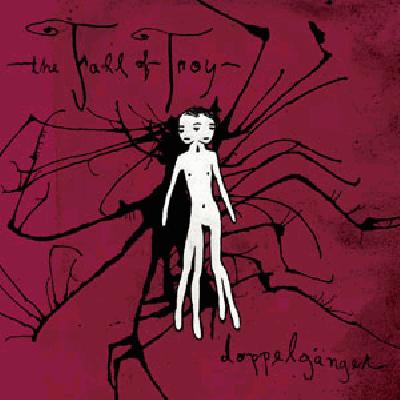
Doppelgänger, released in August 2005, stands as their magnum opus. The calling card for this album, and the band by proxy, is the song "F.C.P.R.E.M.I.X.," featured in the aforementioned video games I logged hundreds of hours playing. I was 12 when I heard the song for the first time, and its frenzied energy blew me away. It ultimately acted as sort of a precursor, in a time before I completely embraced heavy metal or any kind of alternative music during my high school years. Blame it on nostalgia, but I hold the song and this album in very high regard for being that gateway for me.
I'll save my detailed thoughts on "R.E.M.I.X." for a little later on, but the last thing I'll say for now is that it is one of four songs lifted from the band's 2003 self-titled debut album, completely reworked from the ground up for the sake of this one. If you listen to both albums, you'll definitely pick up on the band's knack for complex and explosive riffs and song structures, even with the earlier album's raw and rudimentary presentation; the self-titled album was reportedly recorded in just one take! Suffice to say, though,
Doppelgänger boasts of a polished and fleshed out sound for the band, keeping their trademarks and identity in place, but running things to their logical conclusion and fully realizing their artistic vision. With all this in mind, we strap in and brace ourselves for a visceral assault on our mortal eardrums. Opening romp "I Just Got This Symphony Goin'", one of the four mentioned tracks the band retooled, wastes no time shooting us out of a cannon into the sun. It keeps the chassis of its predecessor intact, but rounds out the production nicely.
Pressing right along, we reach the first original composition "Act One, Scene One", which illustrates the band's strength at marrying crunching and dynamic riffs with Tom Erak's almost glistening singing. For a band that hangs it hat on seemingly untrammeled chaos, Tom's melodies and hooks add an extra dimension to an already great foundation. Then we return to what is still my personal favorite: "F.C.P.R.E.M.I.X." The acronym on the original song is—holy f*ck I'm actually gonna type this—"F.C.P.S.I.T.S.G.E.P.G.E.P.G.E.P." ; What does it mean? Some have speculated a few humorous possibilities, and the band themselves have said it means nothing. All I know is that it's a f*cking killer song. The original is a bit slower, with the pace ramped up for this remake. Scanning the lyrics, Tom seems to be closing the book on a relationship, but leaving the door open to try again in the future. "I'm leaving on this journey, maybe someday I'll come running home to you," he ponders before kicking into that iconic singalong chorus. The awesomeness only builds until we reach that captivating bridge, where volcanic riffs slowly give way to one of the most mosh-worthy breakdowns ever dreamed up. Tom even used the pedal to self-create all the cool guitar filters and effects going on. It still stands as one of my favorite songs of all time. I'm so thankful I whacked away at a plastic peripheral and homered with A-Rod all throughout middle school with this as the soundtrack.
As we continue, a few highlights (though the whole album is goldly) jump out. There's another one of the remakes, "Mouths Like Sidewinder Missiles," with its sizzling fret work, another cool main hook from Tom, and some fervid drumming from Andrew on that infectiously catchy outro. There's "Laces Out, Dan!", where Andrew's drumming again comes to the fore to start us off. Tom's voice reaches stratospheric heights while Tim's unclean vocals only add to the unbridled fury. His screams on the outro made me chuckle a bit the first time I heard them, but I think the 'crazy' suits the band's personality. There's the hilariously titled "We Better Learn To Hotwire A Uterus," which follows immediately on 'Dan's' heels and makes for another punishing instrumental showcase. And we can't forget the elongated curtain call "Macaulay Culkin," which accounts for almost a fifth of the album's runtime. Perhaps it's by virtue of being eight minutes in length, but this one seems to take the most care with its time, putting all of the band's trademarks on display. It copy and pastes "F.C.P."'s setup of interesting bits in between extended instrumental sections, sort of coming up for brief gasps of air and then plunging right back into the unforgiving waters. It embraces a flair for the theatrical in its back half, serving up the album's lone slice of stillness before the last hook from Tom, which errs once more on a jaded perspective; "You walked in front, I ran behind," he laments. He shreds a little bit more with some cool distortion as the whole thing slowly ticks towards its end. With
Doppelgänger now finished, you sit back, turn around to see your living room looks like a tornado just touched down, and take in the legendary smackdown you just treated yourself to.
Doppelgänger is the obvious career record for these uniquely talented boys from Mukliteo. It's forty-four minutes and thirty-three seconds of well-constructed mayhem. Such a concept seems oxymoronic, but that's what makes these guys special. They can harness their gifts and channel them into a deliberate and brilliant experience. It's been about fifteen years since I found this band in what would be, unbeknownst to me then, my first steps towards falling in love with a whole subset and subculture of amazing music. With the album set to turn 20 next month, I can only imagine what the impact was like for people who came up in it back in 2005. The Fall of Troy are indelibly etched into eternity in the world of mathcore and progressive post-hardcore. They are pillars of this kind of music and rightfully so. For me, it started with one song, something I didn't, couldn't, search out, but stumbled upon during a mundane Saturday afternoon as a youngin. The Fall of Troy's
Doppelgänger: quietly influential on me, loudly influential on an entire genre. When that's the case, you can only betoken it the distinction of being an all-time
classic.