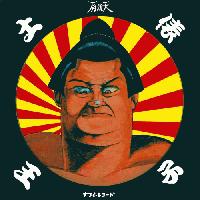
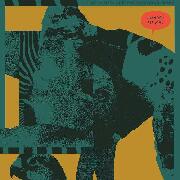
Review Summary: A disturbingly haunting debut that perfectly demonstrates the unique avant-garde-new wave style of Uchoten.
With the exception of Hikashu, there are hardly any Japanese new wave-esqued groups as bizarre as Uchoten. Formed in the early 1980's, the group sparingly did any shows or promoted... until 1983, when they suddenly released their debut album, the independently released "Dohyou Ouji". Coming entirely out of left field, the group takes influence from the aforementioned band, Hikashu, and creates a contorted sound, chockful of demented lullabies, acidic singalongs and tons of new wave static thrown all over the place.
The album opens up with the three-minute long intro, which consists of frontman, Kera, conversing with some girl, and both of them ending up crying. Then, the twisted album kicks off with "Joshidai Sei", which has a rather playful tone to it. The track ends up sounding like a Japanese musical version of Pee-Wee's Playhouse on too many acids. A screwy track, but then again, that's exactly what Uchoten's good at. "Komaru ze Kariage" then comes on, with an equally playful tone to it, but with minor grim undertones to it. "Komaru ze Kariage", essentially, can be thought of as a parody to early-80's JPop, which then had a bubbly, old-time swing to it. "Komaru ze Kariage" manages to take those JPop stylings, and contort them to something wonderfully twisted. An entertaining piece of schizophrenic new wave. "Uwasa no Passing Light" is an addictive ditty that follows an upbeat sound, and has Kera dramatically pacing alongside the track. The bubblegum synths in the track adds a nice element to the track, and it winds up being one of the most ambitious tracks on the album, and one of the catchiest as well. "Ne! Ohoshisama" is a haunting lullaby within the album, and has a voice (assumably Kera's) reading in a highly distorted voice, along an innocent sounding keyboard sample. One of the most haunting displays in Uchoten's catalog (along with most of Japanese music in the 1980's), it ends up leaving trails of nightmares embedded within the brains of listeners for a few nights to come. "Sumo-san no Uta" brings back the album's innocent-sounding tone, only this time around, it follows a sludgier type of breakdown, akin to a slightly angsty Howdy Doody. The screwy samples in the track carries forward Uchoten's unique style even further.
"Tsukkonda Ohanashi" is an early live recording of Uchoten, and it starts off with Kera making a dramatic introduction, before the song sludges away. This song is a wonderful mixture of psych pop and Uchoten's signature style of experimental new wave. The unorthodox combination makes the track end up being one of the most memorable songs on the album, and the synth stabs makes sure the track is laced in your psyche for at least two-three hours. An effective track, and definitely one of the best ones on the album. "Akai Geta no Onna no ko" is a hyperactive sounding track that is another addictive song on the album, following a seemingly straightforward style, but with various unorthodox styles still in tact (such as the guitar solo in the middle of the song). A damn good song, and is as close to 'normal' Uchoten as one can get during this era. "Gyuunyuu Gokkun" is an interesting song, full of progression and impressive song instrumentation. Clocking at near 10-minutes, the listener hardly recognizes the time length, due to the various elements thrown in the track, and the amount of progression layered within the song itself, making sure the numerous elements don't overwhelm the listener. The sheer ambition and energy within the track signals influence from groups like Jagatara, who first made a breakthrough a year before "Dohyou Ouji" was released. A catchy, interesting take on an album epica. The album then makes it close with the final track, "Motto Satisfied", which follows a more mellow pattern, and is probably the closest to mainstream friendly Uchoten got, along with "Akai Geta no Onna no ko". The song shows Kera calmly making an attempt to croon along the mellow styling of the track. Kera's unorthodox vocal style and echo effect of his vocals, along with the various sound effects within the song, make the end result still as unique as the remaining tracks on the album.
To best sum up the album, think of a merry-go-round covered in rainbow-colored maggots and encrusted in mud, and that is exactly how the entire album ends up sounding. An acidic take of mainstream pop, Uchoten's 1983 debut successfully carves a pathway for the band to follow on for nearly another decade. Recommended sheerly to experimental music fans, and absolutely NOT for traditional fans of mainstream JPop. There's no wonder why the album made such a smash in the 80's underground scene...