Review Summary: "Cosmic climax, OOoOuUOoOUOuoOOH!"
Charles Mingus loved the
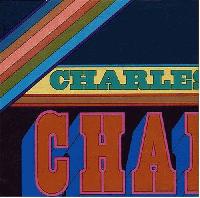
Changes albums and rated them as some of the best he'd ever made, and I think so too! Specifically
Changes One —
Changes Two may keep arguably a more even keel, but it doesn't raise the roof quite as high or in as many guises.
Changes One, though, mmm… I find it hard to imagine a discerning Mingus fan left wanting by this one. Across four girthy cuts, Mingus and his band pave over a bold range of compositions, kicking off with the instantly recognisable post-bop jaunt of "Remember Rockefeller at Attica" (the many lively qualities of which are offset by the police brutality alluded to in the title), only to whizz through however many forays into free jazz, blues, incendiary soul, and hints of composerly third stream.
Why's it all sound so good? Well, uh, start with the band in question, who were distinguished both as one of Mingus' more stable line-ups, and also through their generational make-up. With the exception of long-time drummer Dannie Richmond (who played on practically every Mingus record you've ever heard of bar
Pithecanthropus Erectus), these cats were uniformly of a younger breed, born a full two decades after Mingus with saxophonist George Adams the eldest with a 1940 birthday. Whether as a by-product of this senior-junior split, or of a comparatively 'mature' temperament one would ascribe to a gradually aging Mingus,
Changes (both of them) are easily among the most disciplined and polished outings the man ever put to wax. Don't be a silly hog and read this as a suggestion that he had lost his iconoclastic flair – the hollering, slobbering, swaggering "Devil Blues" quickly puts paid to that argument with its cartoonish brimstone romp, reprised from the debauched piano-man days of
Oh Yeah and spurred on to fresh excesses – or that his approach to composition had dulled its claws: the vast five-part suite of "Sue's Changes" is as ambitious as anything he'd written, its excursions into blistering free harmony every bit as chaotic.
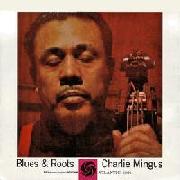
However, there's something streamlined and controlled about these pieces that overrides their many individual extremities and produces a colourful showcase of all Mingus' assorted fortes in rare harmony with one another. It never packs the rollicking force of, say,
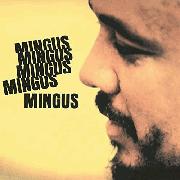
Blues and Roots,
Tijuana Moods or
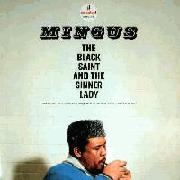
The Black Saint & the Sinner Lady, but thanks to its stylistic range and the precision with which the arrangements carve out space for each performer (in a subtle shift for Mingus, the weight carried by each performer here plays as key a role as full-band interplay), it achieves parity of expression for the full spectrum of all things Mingus in a way that the bitching jazz-fever of those earlier records spared little time for. True to its title,
Changes One pivoted between the swinging and the sombre, the maniacal and the melodious, the sprawling and the straightforward, seeing it all off in such fine style that these customary sets of opposites end up keeping each other hearteningly fine company.
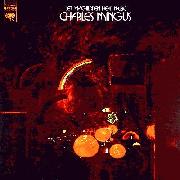
One finds ample proof of this in the bafflingly cohesive sequential placement of two songs as at odds with one another as the callous "Devil Blues" and the sentimentally-charged "Duke Ellington's Sound of Love". This latter track, a tribute to Mingus' recently-passed great hero, makes for the record's chief masterpiece: a glassy-eyed epic that conjures up as much Ellingtonian whimsy and sophistication as it can muster, channelling it through an exquisitely tasteful set of performances, each detail of which is accentuated by the piece's mournful tempo. The upshot of this skirts the maudlin territory that had partially bogged down Mingus most recent milestone record (1971's
Let My Children Hear Music) and lands as one of the most emotive pieces in his discography, with a handful of the record's strongest performances to boot. Mingus' own bass solo is surely one of his finest recorded moments, every note delivered with the utmost delicacy and pathos, but he's given a run for his money earlier on by Don Pullen on piano, whose crystalline turn in the spotlight could make any tender-hearted punter reach for their handkerchief. Pullen's contributions more widely make for this album's not-so-secret weapon, his performance often the driving force of the band, his style a perfect double-act between the unbridled showmanship of jazz and the classical precision Mingus so admired.
Changes One finds itself well-armed as such to juggle everything Mingus could throw at it. It's not quite a contender for a place in his podium – "Devil Blues" is at once too indulgent and burdensome to lend credibility to that argument, fun as it is on first exposure – but it is a remarkably comprehensive record that ties together a previously disparate range of his strengths, and comes out undeserving of the neglect generally given to his' post-1971 output. Good gravy.