Review Summary: A star on her own terms
In recent years, Tinashe has exuded little more than Olympic-level composure, but her eighth studio album, under the concise title
Popstar, unexpectedly strips the mask off the characteristically flawless artist. Former aspirations and guideposts lose their importance upon the realization that the chase for fame and popularity has dragged on, transforming into a surreal parody of itself. There turns out to be not that much room under the sun, yet this is by no means a reason to give up. Therefore, the familiar glossy pop sheen is replaced here by the revved-up yet vulnerable energy of a creative person exhausted by endless swings and the all-consuming race for marketing metrics.
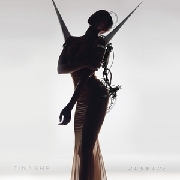
The album cover itself sets a sobering tone: distant stars reflect in the singer’s eyes, serving as a reminder of an ever-elusive and rarely attainable goal. At the same time, the unpretentious yet uncompromising title of the record emphasizes that Tinashe unconditionally considers herself a star. This monosyllabic dryness conceals a maximalist and rich sonic palette: pop, R&B, hip-hop, jazz, bedroom pop, and new age blend together here. And although the roots of this sound trace back to her debut album
Aquarius, on
Popstar Tinashe’s captivating smile reveals much sharper teeth, confidently picking up the banner once raised by
Charli XCX in her reflections on the difficult lot of modern pop divas.
The opening track,
Sunglasses, with its dreamy melodic underpinnings, immediately signals the singer’s lofty ambitions, elevating music to the rank of her own religion, inseparable from the constant fear of remaining unnoticed. In
Melatonin, the artist plunges into a ruthless techno frenzy at the intersection of hyperpop and acid house, relentlessly driving the track forward. Next, the emotional temperature shifts abruptly in
Empty Stadium, where Tinashe openly confesses her fear of emptiness and rejection, trembling at the prospect of remaining underappreciated against a backdrop of anxious strings. Following this, the record takes a necessary breather with
Flashbacks, which conveys the negative psychological toll of popularity through a silvery vocal delivery and smooth instrumentation.
The ballad
I’d Rather Be Alone returns the singer to more familiar R&B and pop territory, where sobering guitar riffs and dark synths help her admit that she is not afraid of solitude. The album explodes once again on
Crash Out, where over assertive trap beats the artist openly challenges haters and the rotten underbelly of the music industry. The whimsical celebration of life that follows takes the form of catchy dance rhythms: the hypnotic
Pillow Fight with its enchanting piano breakdown and the heavy country-infused
Nobody Wanna Dance Anymore help temporarily brush aside personal anxieties for the pure magic of the moment.
Gradually, the album delves deeper into introspection: in the psychedelic track
Twentyfive Eight, Tinashe takes a sarcastic swipe at her own ambitions, where an immediate drive for creation coexists with the digital equivalent of the rat race – and maintaining peace of mind is what matters most. The title track resides at the intersection of alternative R&B and synth-pop harmonies, after which the album rapidly plunges into a hyper-digital aesthetic with robotic backing vocals in
Brainrot, while the relaxed nonchalance of
Cloud 9 serves as a substantial, climactic release right before the finale.
This midnight marathon concludes with the unexpected acoustic track
Heavy Weight, in which the artist finally sheds the unbearable burden of perfectionism and the exhausting chase for the chimera of an unattainable and nonexistent ideal. The period placed by the album cuts the heavy anchor of accumulated grievances, turning this caustic, stylish, and daring work into a true jet engine operating at full throttle, capable of finally launching Tinashe into the long-awaited spotlight.