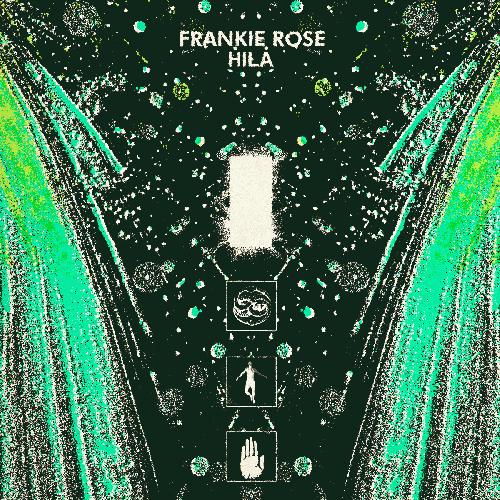
Review Summary: Where moonlight breaks through the digital shadow
For fifteen years, Frankie Rose has quietly and steadily built her authority in American indie music, avoiding unnecessary and often distracting noise. Having passed through
Vivian Girls and
Crystal Stilts, she set sail on a solo career, gradually shaking off the weight of past achievements – a trajectory reinforced by her shift toward synth-pop aesthetics on the record
Love as Projection. Her new album,
Hila, rejects familiar moves in favor of a convincingly mature form where digital soundscapes move toward even darker and more textural spheres, and the danceable pulsations of the past intertwine with existential melancholy.
The record was born after exhausting tours with seasoned rockers like
The Jesus and Mary Chain and
Swervedriver, and was recorded in Rose’s own studio with the participation of drummer Justin Welch from
Elastica and
Lush.
Hila confidently crossbreeds muscular post-punk and harsh electronics, which surprisingly coexist organically with fragile melodies. It feels as though during the work on the album, Rose was actively listening to early
The Cure and
Cocteau Twins, because here we encounter a notable cocktail of neon shine and a somber aesthetic, where the music immerses the listener within itself while maintaining a certain emotional distance.
The record kicks off with the track
Olo – a grandiose piece reminiscent of
Tangerine Dream’s synthesizer soundtracks and
Peter Gabriel’s experiments. Rose’s vocals here flutter like a tired, disembodied spirit trying to transport us into an otherworldly reality, before giving way to more accessible synth-pop. Following it,
Cant Be Wrong smoothly moves alongside the listener from optimistic pop territories into the twilight zones of more restrained electropop with a relaxed atmosphere and a shifting vocal.
Gradually, the album acquires increasingly pronounced gothic shades, turning into something like a cold sonic canvas. In the composition
Return to Dust, a dense and driving bass leads the listener all the way through, and the subsequent
Shadow Twin begins with a characteristic synth sounding like a call or a beckoning gesture, making one forget everything else in this immersive space where the undefinable emotions of sadness, loss, and acceptance collide.
The track
Rainman paints aerial landscapes above storm clouds filled with disembodied echoes. The title track leads us deeper into the rainy night atmosphere of a metropolis full of unrequited desires and moonlight breaking through artificial lighting. The composition opens with an electronic cello and is adorned with a saxophone and digital synthesizers, referencing the romance of a solitary walk through the night city.
The tension reaches its peak in
Manifest with its merciless, almost industrial beat and a sense of unresolved internal struggle, where unyielding drum machines combine with multi-layered vocals. It is followed by
Best of Times, which organically weaves keyboards and saxophone into the gloomy darkwave, after which the track
TV Star dissolves into space, feeling more like a shifting and fragile fragment that leaves the question open rather than putting a clear period at the end. Everything concludes with the number
Velvet Refrain, which unexpectedly flings open the doors to a pre-dawn morning thanks to its refined tempo and Rose’s invariable melodic flair.
The entire record demands an engaged and attentive immersion by the listener into personal tragedy through the prism of blurred emotions. Although grief and loss are timeless themes, Rose manages to speak about them without cheap melodrama and theatrical straining, turning
Hila into an attempt at a dialogue between her pain and a healthy skepticism toward the structure of the world, where the music reflects the non-linear logic of the human mind trying to cope with loss.