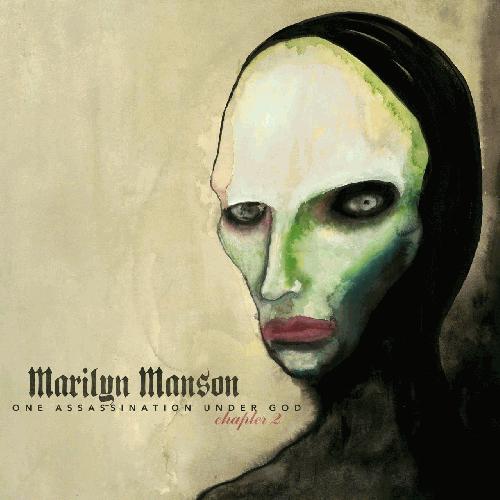
Review Summary: Chapter 2 isn't as immediate or as varied as its predecessor, but it's an excellent conclusion to a strong comeback.
If you were only half paying attention to the flow of
One Assassination Under God – Chapter 1’s tracklisting, “Sacrifice of the Mass” might seem like an anticlimactic end to an otherwise blazing return to form. That’s because, as the title gives away,
One Assassination Under God – Chapter 1 is one half of Manson’s diptych; one piece of a complete story. Narratively
Chapter 1 leaves the listener on a bit of a low-tempo-d cliffhanger; describing himself as
“dressed in [his] mortuary best” with the wolf at the door, you can feel the claustrophobic confines of Manson’s existential isolation as the solemn chimes of the acoustic guitar cradle everyone out into a cosmic oblivion. As much as I love the goth-drenched elegy, and regard
Chapter 1 as being Manson’s best work since
Holywood, I can see why some would think “Sacrifice of the Mass” is a dull, wet thud to end the album on, especially coming off the back of “Raise the Red Flag”. However, like
Avengers: Infinity War,
Kill Bill or
The Matrix Reloaded,
Chapter 1 serves only one half of a complete tale. As I touched on in
Chapter 1’s review, this project is a laser-focused, tightly packed and narrative-driven body of work that has the same meticulous consideration put into it as
Holywood, arguably more so here. At the time, while it wasn’t guaranteed there would be a part two, it was pretty obvious there was going to be a conclusive instalment given the ‘Part 1’ title and how the LP ends, which furtively slips out the back door.
In hindsight, it’s clear Manson and Bates mapped out and recorded an eighteen-track narrative before his return in early 2024, one that would be split into two records: a story chronicling addiction, betrayal, isolation, self-reflection, recovery, fighting the allegations, and his eventual rebirth. Ultimately
Chapter 1 lays down the groundwork for most of these themes, but generally speaking the first chapter reflects on the person he was – admitting to his hedonistic past and finding a way to move forward with his sobriety – while denying the allegations and the betrayals of the last half-decade being a reoccurring thread used throughout the record. While
Chapter 1 can take the offensive position at times with the likes of “One Assassination Under God” and “Raise the Red Flag”, the album feels far more reserved and on the defensive, allowing for a more introspective experience. So, if
Chapter 1 focuses on the man he was,
Chapter 2 subsequently focuses on the man he has become, with the album’s singles wasting no time in disclosing that fact. “Exit Wound” taps into a similar vein from thirty years ago:
‘Can't stop the bleeding I'm not healing soon, you shot the world I am the exit wound’, a statement that broadly touches on how Manson’s career has essentially been tied to the “Streisand Effect”, and how his attempted cancellation in recent years has ultimately brought back the Marilyn Manson persona. This was then shortly followed up with “Front Toward Enemy”, a similar analysis on his place in society but one that more brazenly sends out a clear message: he isn’t rolling over on the allegations or his attempted cancellation.
For me, the return of the Manson persona is a fascinating thing to observe, because if you look as far back as 2007 you can see Brian Warner beginning to strip that persona away. In a lot of ways, anything after
The Golden Age of Grotesque sees him trying to connect with his audience on a more personal level, which is why we’ve seen so many stylistic shifts in between the volatile industrial-stadium-anthems of 2004 and the cosmic rock tunes of
We Are Chaos. By 2020 he had almost entirely removed the visual pomp and immediate industrial energy that made him a household name, acting more as Brian Warner “the artist” than Marilyn Manson the character. However, when the allegations came out shortly after the release of
We Are Chaos, Brian Warner retreated from the public eye and returned as a more mature version of the Marilyn Manson character, one that amalgamated his shrewd social and political commentary with the grounded personal approach he’d been running with for the last twenty years. And so that’s what
Chapter 2 is all about. On top of the aforementioned singles, tracks like “All the Vilest Things” – where Manson hisses
‘You tried your best to destroy me; I don’t want revenge because you only made me stronger’ – and “The Arsonist” show a clear-cut message centred around recent events and how it’s shaped and created this iteration of Marilyn Manson. It’s a proclamation to fans and haters alike – we’re seeing the resurrection of the Antichrist, taking a full-frontal assault to his detractors and embracing his position on the firing line once again.
In terms of Manson’s lyric writing and themes, this is as thoughtful and well-written as
Chapter 1, which goes without saying it shows Manson at the top of his game. Like its predecessor, it’s a web of religious metaphors used to weave the last two pillars of this story’s arch together: fighting the allegations and his rebirth, and honestly, trying to decipher each track’s message is one of the best aspects of listening to the record. While
Chapter 1 has some excellent lyrics in it,
Chapter 2 feels a lot more locked into the story-telling aspect, for reasons we’ll get into shortly. However, when you listen to
One Assassination Under God in its entirety, it not only forms one of the strongest projects of his career,
Chapter 2’s focus on lyrics gives the listener a bit of a palate cleanse after
Chapter 1’s instrumental-heavy songwriting.
So outside of the concept and themes, what is the style of music representing this closing chapter? Well, interestingly, it’s not the metal-heavy return its singles purported it to be.
Chapter 1 was entrenched in a gothic atmosphere, but there were lots of other things going on to make it fresh yet rooted in his golden era, shall we say. It’s clear now “Sacrifice of the Mass”’s gothic disposition is a transitioning stage for what’s to come for
Chapter 2. To condense it down to a sentence,
Chapter 2 feels like
The Pale Emperor, if it lived in Dracula’s castle for 300 years. Despite what the singles imply, and the more standoffish lyrical approach which would have benefited more from a heavier sound, the reality is that
Chapter 2 takes on a much less abrasive approach, putting the duo’s creative efforts into crafting rich, ominous atmospheres over big riffs. It’s an authentic goth rock album, and honestly, it’s a style and approach we’ve not heard from Manson before – a steadfast experience that owns the moody guitar passages and morose electronics synonymous with the genre. With the exception of the singles, and aspects of “Unalive” and “The Arsonist”, squelching chorus effects over emotive guitar parts and basic 4/4 drum patterns are the order of the day here. And I’d be lying if I said I wasn’t a little disappointed with the creative decision, because “Front Toward Enemy” and “Exit Wound” bask in adulation for
Antichrist Superstar and
TGAOG, respectively, but serve them up with a more modern and mature interpretation of those sounds.
That being said, while
Chapter 2 is less immediate on a first listen, it quickly reveals its qualities and delivers a nice counterpoint to
Chapter 1. There’s a lot of layering in the tracks, with loads of glorious, haunting goth-drenched ambiences underneath it all. At times songs like “Don’t Answer the Door” and “None of the Suns” give off an 80’s new-wave vibe, adjacent to something you’d hear on The Lost Boys (which probably isn’t a coincidence, when you consider he covered “Cry Little Sister”), but overall, it’s hard to fault the consistent mood being carried throughout. In terms of which side is stronger, it would be a little unfair to compare which chapter is better since it’s an eighty-six-minute concept album designed to be heard in its entirety, but if I had to pick a side, I’d have to go with
Chapter 1. Even though the quality here is fantastic, this tends to operate on a plateau with minimal peaks and troughs. For me the track “One Assassination under God” is one of my all-time favourite songs from Manson’s catalogue, and there’s nothing on here that comes marginally close to that level of quality. In fact, the track is so good, part of me laments
One Assassination Under God doesn’t touch on this grand, cinematic and atmospheric goth-meets-metal sound for any of the other seventeen tracks. “Enantiomorph” is a decent closer, but it would have been fitting to design the song in a similar vein to the title-track, like a bookends with a more cathartic conclusion overall. Still, niggles aside,
Chapter 2 is an excellent follow-up to
Chapter 1, with
One Assassination Under God overall standing tall with Manson’s Triptych records.