Review Summary: Free music that lets you look into the artist's soul.
The Deus Ex franchise has, for the most part, been a brand name renowned for its innovation, style, and prophetic conspiracy-laden storylines. The original Deus Ex is a masterpiece that was years ahead of its time, and still holds up surprisingly well today, however, Deus Ex: Human Revolution was a video game that captured me in so many ways at the time. Ironically, I went back to it only a couple weeks ago and it still remains one of my favourite video games ever made – an artistic and technical triumph with an intriguing plot, slick gameplay, and an arresting style and aesthetic that still stands out today. Yet, the thing that gels this game’s idiosyncrasies together is its phenomenal score, composed by Michael McCann. Since being released fourteen years ago, I still frequently come back to it and revere its moody, poignant atmosphere, Middle Eastern influences, and infectious grooves. It is the apotheosis of video game scoring, because it not only elevates and compliments the game’s style and what it’s going for, the music is that good it can be heard as stand-alone music for, evidently, fourteen years without it ever becoming boring.
Deus Ex: Mankind Divided was a different matter though. For Mankind Divided, it was a game made with love and care from its developers, but was wrought with studio interference – at a time when studios were getting a feel for how far they could rip-off their customers by chopping up their games and selling parts of it as DLC on top of the base price. Despite the developer’s best efforts, Deus Ex: Mankind Divided suffered terribly from brutal deadlines and gross machinations to make as much money as possible, which ultimately created a sequel that felt underwhelming and patchy, putting it lightly. At the time, the game’s score brushed me the wrong way for being more of a collaboration album with other composers than an exclusive project written by McCann. While it was a solid effort, I felt it lost that spark
Deus Ex: Human Revolution had. It wasn’t until a couple of years ago where I went back to it and thoroughly conceded that, while
Deus Ex: Mankind Divided wasn’t the inimitable flash of genius its predecessor was, it was still a bloody strong release. Furthermore, Sascha Dikiciyan (AKA Sonic Mayhem) has some of the best tracks on it. Dikiciyan’s style is more abrasive and makes you aware of his presence, with the mechanical sledgehammers “Battle for the Future”, “Apex Tower” and “Martial Law”, but he also respects McCann’s sensibilities and builds upon that ambient style with some gorgeous Bladerunner-vibing haze, found on the likes of “Prague”, “G.A.R.M”, and “Safehouse”.
So, it’s rather serendipitous that I should find myself delving into this world again recently, only to find out that Sasha Dikiciyan has dropped an album’s worth of unused material and demos that didn’t get used on
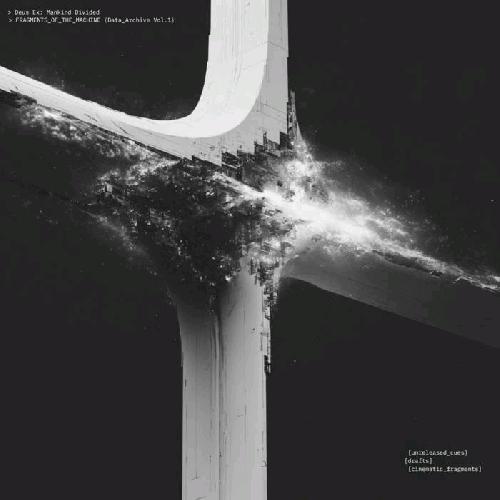
Deus Ex: Mankind Divided, for free, on his Bandcamp, prompting me to giddily explore these demos and write this very review. In short, while this is technically a hard drive dump of songs that didn’t get used for the game or its trailers, it doesn’t diminish the quality being presented on
Fragments of the Machine [Data Archive Vol.1]. Songs like “DeusEx_MD_DespMeasures_Ambient#2_beta4”, “DE_MD_Theme_idea_4_1” and “M07_590_CUT_THE ORCHID AND THE BOMBS_MUSIC” all have familiar ideas and sounds we’ve heard on the final version of the album, but the likes of the haunting “DE_MD_Idea_2_15” and the seedy nightclub dancer “DE_MD_InfoLink_StripClub” are completely new, and it’s absolutely thrilling to listen to. This is very similar to HEALTH’s
Dimensions In Noise EP which had early beta versions of what would come to be
Max Payne 3 songs, and I find it fascinating to listen to this kind of stuff; it’s a window into the artist’s mind, their thought processes, allowing you to see and hear these great ideas in their raw state before they take on their final form. At the end of the day, Sasha Dikiciyan has kindly released this stuff to fans, so at the very least, the only thing you’re losing is the time listening to it, but frankly, demos or not, this is still a surprisingly consistent and enjoyable release, and a damn fine way to spend your time if you like this type of music.