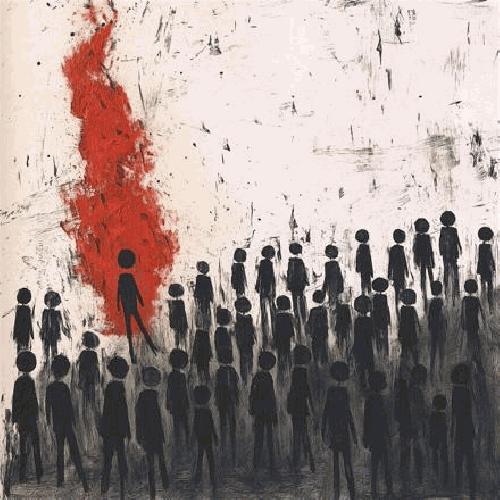
Review Summary: "We're still alive!"
When Three Days Grace served up their third album with Matt Walst at the helm,
Explosions, in 2022, I commended them for weathering all the adversity that had defined their previous decade up to that point, and Matt in particular for having firmly carved out his own niche within the group. I wagered that he had once and for all transcended the shadow of his predecessor, the band's founding frontman Adam Gontier. I remember when I submitted my review of the album (which I don't stand by, that album has aged
poorly), a colleague offered feedback that, among other things, specifically highlighted the unending Adam-Matt comparisons. He mentioned that it was 'telling' that most of the discourse surrounding Three Days Grace continued to be about Gontier. I racked my brain and realized that was correct. I, acting in good faith, wanted to give Matt his dues for keeping the ship afloat and making the role of the band's leader his own. But in constantly referencing Gontier's departure (as did
everyone with an opinion about this band), I was unintentionally reinforcing the elephant in the room. I vowed to myself that whenever Three Days Grace got around to dropping their next album, I would let Matt and the band's music do all of the talking, and I would make no mention of Adam whatsoever when giving my two cents about it.
Funny how things work out sometimes.
In 2023, Gontier reunited with Three Days Grace for multiple one-off live performances, the first of which occurred within days of my seeing the band in concert for the first time. Imagine my jealousy for the Huntsville, Alabama residents who got to witness that seismic surprise event. With Gontier also publicly squashing his beef with the band, most notably drummer Neil Sanderson, whom he'd spoken negatively about in years past, this gave rise to speculation that Adam could return to the band full time. Fast forward to October 2024, and fans got the announcement they'd been waiting for. Adam Gontier had officially rejoined Three Days Grace, with Matt Walst remaining on board as a co-lead vocalist. In this development, the group opened up the potential for something truly special and rare in the music industry; a founding lead singer returning to his old band, but standing alongside the man who replaced him, manning the wheel together. As far as the music itself was concerned, this also opened the door for new stylistic possibilities, and a cohesive marriage of the band's two eras. Before long, the band's eighth studio album
Alienation was announced, preceded by lead single "Mayday," which enjoyed a lightning fast 5-week sprint to the top of the
Billboard mainstream rock charts.
While the return of Gontier to the fold is all kinds of triumphant and exciting for those of us who've enjoyed this band for so long, it does put away any chance Matt had of truly reshaping the band's identity around him; it would be a bit hard to not talk about his predecessor now that Adam is back in the mix. But like me, I'm sure Matt doesn't give a sh*t, and he shouldn't. The narrative surrounding this album is and should be one of forgiveness and friendships reaffirmed. The renewed camaraderie imbues the album with a buoyant glow and spirit that just doesn't exist in the band's back catalog. But, of course, we can't gauge the chemistry between these new partners in crime without actually listening, so let's dive in.
Alienation does honestly stumble out of the gate a bit, with its weakest moments being the opening pair of "Dominate" and "Apologies." While "Dominate" features a rad guitar solo from Barry Stock, it's marred by sloppy lyrics, as Gontier sheepishly brays "The sun don't rise/the sun don't set/it's just the world spinning/think about it" on the intro. These lines don't mesh with any of the rest of the track's intended anthemic vibe, and the song's other pitfalls aren't doing it any favors to begin with. For one, it feels like a retread of "Champion," one of the biggest offenders from
Explosions. Moreover, it feels like a B-side from any of the band's three albums with Matt as the lead, and is not by any means a yardstick for how well Gontier re-ingratiates himself back into the band. "Apologies" fares marginally better, with Matt's cringeworthy rap-adjacent delivery being tough to sit through before the payoff of Adam's gritty choruses.
From there, the band fires on all cylinders for about the entirety of the remaining thirty-five minutes and change that comprise
Alienation. "Kill Me Fast," which sees Gontier take the lead for the majority of its runtime, is easily the best ballad on here. A persistent critique I've seen about the album is the production and compression of the vocals, with Gontier even addressing these concerns on social media ("it's not 2006 anymore"), and I think this track is one that works well in part because it ditches many of the bells and whistles found in other parts of the record. Gontier has also cited "Kill Me Fast" one of his favorite songs he and the band have ever written, and I think it's definitely one of the album's best in that regard. The track explores the conflicted feelings that come when you're forced to sever ties with someone even though you
really don't want to, even though you know it's for the best. "If you're planning to go, just don't leave any hope that you're ever coming back," Gontier emphatically laments. "Mayday", the mentioned lead-off single, establishes the dichotomy between the two vocalists nicely, bringing with it a celebratory vibe that's sprawled all over the record.
The rest of the album sees a pretty even 50-50 split between Adam and Matt for vocal duties. Certainly the concept (an OG and his successor together) is f*cking awesome, and the two have plenty of chemistry with no feeling out needed. But it would still be just as cool to see them take one or two tracks and go it completely alone, just to switch things up. If you're wondering who's the superior vocalist, it's undoubtedly still Gontier. No shade to Matt whatsoever, and the man deserves all the credit in the world for keeping the band going, but Gontier's presence revives an essential piece of the band's identity that simply couldn't be replicated and was lost without him. The title cut "Alienation," the best anthem the band has conceived in years, is defined and carried by Adam's gripping and heartfelt vocals. In a similar vein, the infectious "In Waves" sees a strong showing from both men, but Gontier is the song's strongest component.
This schism between the two's capabilities is even more evident on "Never Ordinary," which features some excellent guest string arrangements from Lindsey Sterling. The chorus is one of the album's catchiest, with Adam's vocals on the second and final chorus stinging and captivating in a way that Matt valiantly attempts to match, but falls just short of with his more boyish inflections. Both guys harmonize perfectly on the song's bridge, though. "Deathwish", which sees Sanderson ratchet up his drumming a bit, is one of several that wink and nod to the band's past work, as Matt proclaims he's "riding high on borrowed time, with two X's on my eyes," explicitly referencing the band's landmark 2006 album
One-X. By the same token, the lyrics of the aforementioned "Alienation" make mention of
Human and
Outsider, the band's first two outings with Matt.
The album sprints to a strong finish, but even the highest of highlights get points docked for songwriting that can be clunky or repetitive in small pockets. 'We stopped trying to try,' Adam and Matt sing on "In Cold Blood," which is otherwise one of the hardest-hitting bangers Three Days Grace have
ever put to record. While Adam is still doing his thing per usual, Matt deserves co-MVP honors on this one. For all the consensus that Adam is the better singer, Matt's harsh and biting wails assist this track's heavier composition and add tons of dimension to the band's sound. Suffice to say, they each bring things to the table that the other lacks, creating a nice yin-and-yang dynamic that the album is so much better off for having. Hot on "Cold Blood"'s heels is "The Power." 'Time is ticking down like a time bomb,' Adam warns on the first verse. Ya don't say, Adam? I won't nitpick too much on these individual lines, as they thankfully don't disrupt the ebb and flow of the broader listening experience. I would consider "In Cold Blood" and "The Power" as my own favorites from the album, and I'd love to see them both become live staples a la "Time of Dying."
The closing cut "Another Relapse" sees Adam and Matt bringing to life a tale of addiction that feels all too familiar. Gontier, whose battle with substance abuse, depression and suicidal ideation led to so many of
One-X's most personal and harrowing lyrics and who has even relapsed over the years, tells this story like no one else can. 'Maybe just another taste won't kill me,' he ponders. You can tell these thoughts still pop up from time to time. I can only imagine the courage and resolve it takes to stare down these demons and defeat them over and over again. Matt, who to my knowledge hasn't publicly struggled with drug abuse, also enhances the proceeding with lines that really grapple with the gravity of the song's content; 'Nothing ever got me higher than knowing I could fall,' he hauntingly admits. As the song's final seconds tick down, the crunching instrumental slows down and becomes more punishing, adding to the intensity.
Alienation ends on that note, bar none the most emotional and somber the band has recorded in recent memory.
Alienation is the most feel-good album in Three Days Grace's catalog, given the jubilation surrounding Adam's return. I found myself jamming out more so than scanning the lyrics for depth and interpretation, as I was so accustomed to doing in years past. As for the performances, the band's chemistry has never been more solid, and the ambitious attempt at building around two vocalists succeeds gloriously. For Matt, it's easily his best vocal showing since he joined the band in 2013, and it blows away the sour taste left behind by
Explosions. For Adam, his first outing back in the fold washes away the jaded and detached vibes that were painfully apparent on
Transit of Venus, and all of the negativity from his tumultuous split from the group. It may not define their career the way
One-X or any of their early albums did, but
Alienation offers fans an exciting taste of what this, the brightest possible future for Three Days Grace, will look like.
Alienation is
superb.