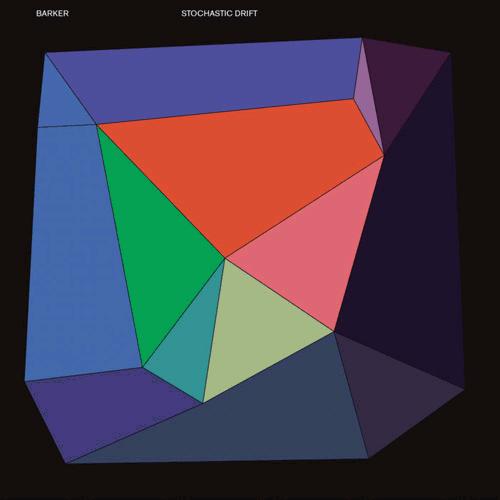
Review Summary: A stunning blend of warmth, precision, and constant inner motion.
Stochastic Drift was my first encounter with Barker’s music, and perhaps that explains why it has stayed with me in such a persistent way. Since its release in April, the album has accompanied me countless times — sometimes with full attention, sometimes as a quiet presence in the background — and with each return it seems to rearrange itself, offering new details, new movements, new spaces to inhabit. It is electronic music that neither overwhelms nor withdraws, but instead creates a steady field of clarity in which the ear can wander.
The album opens with “Force of Habit,” a piece defined by its warm, geometrically precise architecture. A prominent, grounded bass anchors the track while several layers of sound interlock with surgical balance. Already here Barker establishes the central paradox of the record: its sense of physical warmth paired with an almost architectural exactness. “Reframing” expands this idea, driven by a metronome-like pulse and a dynamic bassline that appears and recedes like a tide. The track feels airborne, as if the rhythm were guiding the listener through a series of controlled ascents.
“Difference and Repetition” shifts the focus inward. Its smooth and tactile surfaces are punctuated by microscopic pauses — small absences that give the piece contour without disturbing its flow. There is a quiet intelligence in how these micro-breaks are placed; they make the track feel alive, slightly breathing. With “The Remembering Self,” the album reaches its ambient center. The piece is melancholic, warm, faintly wavelike. It surrounds the listener rather than directing them, replacing rhythm with a kind of suspended introspection.
“Positive Disintegration” is one of the album’s most conceptually revealing moments. What begins as a slow, suburban-evening groove gradually fractures into accelerated pulses and subtle disruptions. Barker lets the track fall apart gently, almost optimistically, as if dissolution itself were a meaningful step toward transformation. “Cosmic Microwave” brings back measured motion — restless but not urgent — decorated with glass-like tones that flicker across a spacious background. It feels like moving through a labyrinth whose walls shift just slightly with each rotation.
The two closing pieces broaden the album’s palette. “Fluid Mechanics” introduces jazz-tinged piano and soft cymbal accents, evoking an underwater stillness that is both mysterious and inviting. And the title track, “Stochastic Drift,” moves from loose jazz inflections into harder, faster rhythmic bursts, before opening into a constellation of space-like tones. It feels like an ascent that eventually breaks into weightlessness.
Across all eight tracks, Barker maintains a rare balance: the music is meticulously crafted, yet full of humanity; warm in tone but sharp in structure; minimal on the surface but rich in the details that accumulate quietly over time.
Stochastic Drift is not an album of grand gestures, but rather one of continuous internal movement — a record that reveals itself in layers, and that remains, even after many listens, surprisingly alive.