Review Summary: Trumpet & keys ambient-jazz duo? Say less.
Ever since being compelled into Vijay Iyer fandom through trial of reviewing
Compassion—the last album from his trio featuring Tyshawn Sorey and Linda May Han Oh—I've had my eyes and ears peeled for new music from the man who had quickly become my new favourite jazz pianist (not that there was much competition). Thankfully, these jazz cats tend to be quite prolific, with their highly collaborative culture opening doors for numerous and diverse projects, so I did not have to wait long for a new strain of Iyer goodness to hit the streets of ECM. And what a joy!
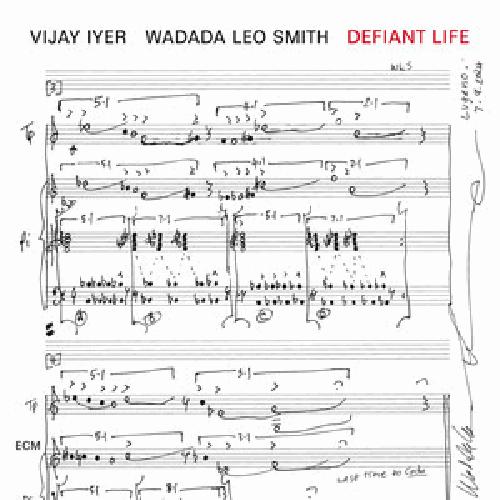
Defiant Life is quite a different beast, "defiant" both in its literal themes and its willingness to subvert the audience. The last time Vijay Iyer teamed up with legendary trumpeter and composer Wadada Leo Smith was on 2016's
A Cosmic Rhythm With Each Stroke, and while
A Cosmic Rhythm felt like a grand spiritual odyssey,
Defiant Life has a markedly more direct and somber tone.
Defiant Life is, after all, the duo's attempt to channel their frustrations of humanity's current and past conflicts into sound—a portrayal of inhumane brutality and the unkillable spirit of perseverance.
There are two songs on
Defiant Life specifically dedicated to martyrs of war and genocide. "Floating River Requiem", for Patrice Lumumba, who fought for the independence of the Congo and Pan-African unification before being assassinated by a separatist group backed by Belgian colonists in 1961. And then "Kite", for Refaat Aleer, a Palestinian activist, educator, and writer, who was killed by an Israeli airstrike on December 7th, 2024. Needless to say, there is a lot of tension brewing beneath the surface of this record. It's a difficult conversation, and one that Iyer and Smith are apt to navigate with grace—and a lot of patience.
Because
Defiant Life isn't in a rush to scream and point for headlines. It's a record that listens and observes as much as it speaks. Iyer and Smith sit together in a quiet room, penning compositions in a comfortable silence that will sometimes leave you groping blindly for the next note. It is tautly minimalistic, pensive, lonely, and the pause between phrases is deafening. The discontent is felt from the first dark rumble of keys and tortured squeal of the trumpet. Smith is entirely unconcerned with sugarcoating reality with smoothness here, and plays with a style that is incredibly raw and expressive, often dwelling in pockets of natural distortion—untamed and gorgeous. Iyer caught me by surprise too by pushing classical piano to the wayside on certain tracks in favour of creating ambient soundscapes with the Fender Rhodes and other various electronics. “Sumud” is definitely the most atmospherically driven track on the album, being dominated by a piercing shimmer and deep bass that spin circles around your head and feet (headphones recommended for this one) as Smith pleads to a deaf chamber. The piano chops you would expect from Iyer don't actually come to heel until the third track, and even then, his playing is heavy-handed and stubborn as he refuses to let go of repeatedly stabbing a single dark chord, the symbolism of which is not lost on me. “Elegy: The Pilgrimage” sees Iyer's soundscape really take center stage as he blends quiet piano with a scene of creaking buildings and a despondent ribbon of light. It is chilling, and the song does not let up on the sense of grief despite harboring an intrinsic beauty in every note.
Alas,
Defiant Life is the type of record that shan't be spoiled by over-explanation; half the joy of jazz is that it can be felt and interpreted in so many different ways. It is an angry, sad record; that much is undeniable, but again, it recognizes the beauty of strength and resistance, and that shines through in the music as well. It is both challenging and peacefully meditative, certainly not for the impatient, yet it can be enjoyed with or without focus. But Iyer and Smith speak a thousand words in a wordless language, and I promise you will get way more out of the experience if you stop and listen to what they have to say with intent.