Review Summary: Simone Simmons sticks to what she has known for twenty years while adding her own little twists.
As the vocalist for Epica, Simone Simons has been a defining voice in the Symphonic Metal genre for over twenty years, releasing eight studio albums over that time (in addition to multiple live albums and EPs). While being part of such a prolific band has had its perks, it also demanded significant sacrifice. The intense schedule of Epica meant that it took Simone nearly fifteen years to finally release her first solo album,
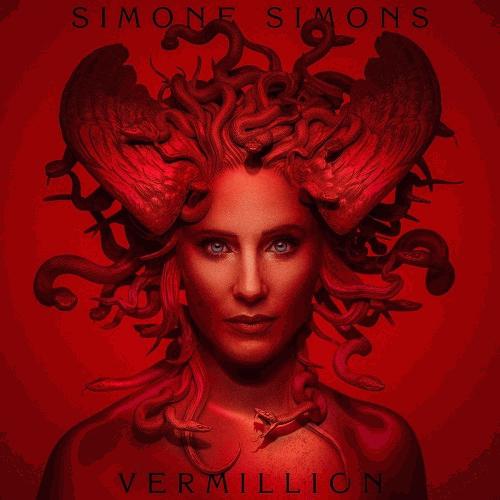
Vermillion. However, unlike many of her peers – including Floor Jansen, Anneke Van Giersbergen, Sharon den Adel, and Charlotte Wessels – Simone chose not to take a mainstream approach with her solo album. Instead, she opted to draw on her experience with Epica while incorporating additional influences. To bring this vision to life, she collaborated with Arjen Lucassen of Ayreon and Lori Linstruth. The result is an album that feels like modern Epica stripped of extreme metal outbursts and progressive tangents in favor of hard rock swagger, darkwave power ballads, and electro-industrial augmentation.
The connection between
Vermillion and Epica extends beyond Simone Simons. The album features Koen Herfst on drums (who filled in for Epica in 2007) and current Epica bassist Rob Van der Loo, along with death growls from Mark Jansen on "The Core" and "R.E.D." Between the line-up and pre-release singles, you might be forgiven for thinking this is simply Epica under a different name. “Aeterna" showcases the prominent Middle Eastern melodies, grand choir accompaniment, and moody atmospherics that Epica fans are familiar with, while also incorporating an electro-industrial transition in the final minutes. The power ballad "In Love We Rust" could easily fit on any Epica release – there’s not much more to say, except that it’s an exceptional Epica ballad. It's not until the third single, "R.E.D," that
Vermillion truly showcases a song not directly connected to Epica’s sound. Although it features Mark Jansen's growls, the Epica similarities end there. Instead of symphonic metal, the song is a swaggering industrial rock anthem interspersed with melodic electronic interludes.
“R.E.D” proves there's more to
Vermillion than just being an Epica-adjacent clone – a point that needs to be emphasized. It wouldn't do Simone justice to simply label every track as "Epica-plus," though it's hard not to. Songs like the electronic rock of "Cradle to the Grave," featuring Alyssa White Gluz on both clean and harsh vocals, the moody melodic darkwave of "Vermillion Dreams," or the doomy "Dystopia," all stand on their own. However, Simone's voice consistently pulls me back to Epica – it's hard to shake twenty years of conditioning. It doesn't help (or hurt?) that the guitar tones and riffs echo
Omega, or that Simone's vocal melodies are so distinctive, even when the accompanying music doesn't explicitly sound like Epica. It’s probably easiest to concede that, essentially,
Vermillion feels like modern Epica combined with equal parts electronics, gothic atmospheres, and hard rock swagger.
I’ve spent this entire review trying to describe the album without resorting to calling every track "Epica plus something else," but that’s really what it is – and is that such a bad thing? I mean, Simone’s solo album is far superior to the misguided attempts at mainstream appeal that many of her peers have made. She stayed true to what she loves, adding her own twists, and the result is fantastic.
Vermillion essentially offers a more streamlined, vocal-focused version of Epica, enriched with electronics, hard rock, and emotive melodic atmospheres – I’m here for it.