Review Summary: This stuff is truly entertaining
Any review of a Dutch Uncles album pretty much always touches on the eclectic influences of the Mancunian band. Among the obligatory names are
Prince,
Talking Heads,
XTC and minimalist composer
Steve Reich. To be fair, such lists usually do not give much of an understanding of the Dutch Uncles sound. Moreover, while you can mention that this or that element reminds you of this or that band, it more often than not fails to give a holistic picture, since usually musicians are good at processing their influences to create something original and independent.
It would be fair to mention that the Dutch Uncles do not come off as show-offs in regard to their distinctive sound. Instead, they wrap it up nicely in a pop envelope. Just listen to their singles to see this. The songs, with their duration rarely exceeding three minutes, at first glance clearly follow the widely accepted structure and rely on the standard verse-chorus-bridge-chorus. Vocalist Duncan Wallis dispenses hooks that let the songs get lodged in your mind.
However, Dutch Uncles are more than that. Their sound is a collage of opposites constantly struggling for your attention. Even though Duncan Wallis relies on the standard structure, his lyrics are vague and eccentric, potentially leading to an increase in the distance between the song and its audience (while mainstream pop music aims to reduce said distance). His vocals do not let go, balancing between cold detachment and emotions boiling right under the surface. The melodies follow in the same footsteps. Intentionally relying on rhythmic drum patterns, they blind you with a potpourri of diverse instruments. The band not only deals with the usual bass, guitar and synths, but they actively add xylophone, harp, cello, marimba, etc. The melodies as though consist of short and at times simple instrumental pieces sewn together into a single complex tapestry of an arrangement that refuses to tear apart at the seams.
Yet it seems as if the band is not entirely happy with the approach, since they’ve been attempting to streamline it over the course of the last few albums to make it more accessible. In some regards this is understandable. Despite their unquestionable merits, the band still remains to be more of a local gem compared to some of their contemporaries, i.e.,
Everything Everything. And this streamlining is what we can see on their first album in six years,
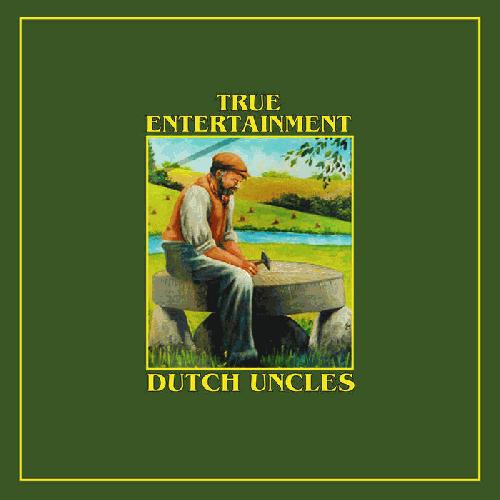
True Entertainment.
The band’s sound has always demonstrated the influence of 1980s music, which is not surprising, really. Still,
True Entertainment is the first album in their discography to feel like 1980s music. Obviously, this shift marks changes in emphasis. While earlier the main focus was on the constant standoff between Robin Richards’ melodies and Duncan Wallis’ vocals, on
True Entertainment the more eclectic moments take a backseat to the synths, highlighting the 1980s music flair. The easiest example of that is the eponymous opener. Its melody is probably the most straightforward in the band’s discography yet. One might deem it as a road to ruin. Nevertheless, Dutch Uncles manage to save the track by employing a lounge jazz style of singing.
Luckily, any early fears are dissipated upon further listening. The second track,
Damascenes, sees the band’s partial return to their trademark, more experimental rhythms – just listen to its pulsating, frantic backbeat. Despite its obvious ‘poppiness’,
Tropigala (2 to 5) hooks you in with a wiry bassline. The same can be said about
Poppin’, which is typical of the later Dutch Uncles sound.
I’m Not Your Dad employs a simple yet dramatically effective piano. And the further the album goes, the easier it is for the listener to come to an understanding – the band is still experimenting, combining time signatures and genres, but not forgetting about the overall picture.
Not everything’s perfect, though. If there is any shortcoming on
True Entertainment, it is its production, which sounds somewhat lacking, especially compared to the popping
Big Balloon. In this regard, the album is similar to
O Shudder. The songs come off sounding subdued, making it easy upon first listen to miss various details and hooks. It takes several spins for the album to start opening up its numerous facets, especially since this time Dutch Uncles pushed their eclecticism to the back, making their experiments less obvious.
Nevertheless,
True Entertainment is a worthy addition to the Dutch Uncles discography. But it also leaves one question hanging in the air: will the band continue to streamline their sound on the next album, or will it be an explosion of energy like it happened with
Big Balloon?