Review Summary: An Oscar Wilde ghost story.
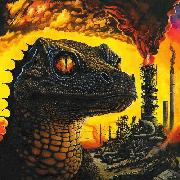
With “Pepper’s Ghost” Arena made a move of a truly progressive band by taking a direction that was perfectly logical and not at all obvious. After releasing three high-brow concept albums in a row, it was time to do something different. The most obvious choice would be to just scale back to regular albums of individual songs, not connected by a single narrative or idea, but that would have been a bit boring, if understandable. Instead, Arena opted to preserve their signature storytelling approach, but to switch from a voluminous novel or a philosophical treatise to a comic book. Even the album’s cover is purposefully bright and colorful and there’s an actual comic book addendum detailing the story told in the album. The story is set in Victorian England this time, deals with a motley crew of demon hunters, and is closer to an action flick like Ghostbusters or a sarcastic take on an established genre like “The Canterville Ghost” by Oscar Wilde.
This approach must have alienated the snobbish part of Arena fanbase and contributed to “Pepper’s Ghost” uneven reputation, but to me it represents the band’s willingness to evolve and refusal from doing the same thing over and over again. Trying their hand at a more lighthearted story after exploring high-brow concepts and existential matters for several albums in a row was a completely viable and interesting move. Besides, it’s not like Arena stopped being Arena. All the core elements of the band’s identity are still in place. Most notably, “Pepper’s Ghost” is not stuck in only one mood and there are plenty of melancholic and dramatic moments which Arena is known for. There’s still that feeling of some supernatural force or spirit observing humankind from above, possibly malevolent and definitively sarcastic, never hesitant to deliver a wry comment on human nature. This feeling of a supernatural presence persisted on all Arena’s albums since The Visitor and it’s still there, although the story is different.
Musically though, there’s at least one crucial difference, and that is shifting of the balance firmly in favor of the guitars. It is quite puzzling, since Clive Nolan remains the band’s mastermind, but it seems like he purposefully lets John Mitchell take control for this one album and unleash the riffs. I even saw “Pepper’s Ghost” being compared to Threshold in some reviews I’ve read ages ago, but I don’t feel it. The bands share some connections, as Karl Groom was involved with Nolan’s earlier Shadowland project, but Mitchell’s playing style is quite distinctive and clearly different from that of Groom. Anyway, never before or since has Arena put such a clear emphasis on riffs, as becomes evident right from the opener “Bedlam’s Fayre.” Mind you, although the focus is more on memorability than on complexity, the song never faulters in the most important task, successfully creating an atmosphere of wild and off-the-wall festivities. Experiments with simpler musical phrases and catchy refrains continue further on, but they are never overdone and are used as foundation to develop the songs into something different. You’ll hear “The Eyes of Lara Moon” starting with an acoustic melody in the singer-songwriter style or “Smoke and Mirrors” featuring maybe the simplest guitar progression in Arena history, but by the time both songs are finished they evolve into something darker and their simplicity turns out to be quite deceptive. Oh, and if the keyboards are not as omnipresent as usual, it does not mean that they are less impactful. There’s an excellent and memorable synth solo adorning each of the two tracks mentioned above and reminding us that Clive Nolan is still the boss here, although this time he mostly rules from the shadows.
Thus, although the approach is different, the album does not represent a complete denial of the band’s roots and abandonment of their signature songwriting tropes. For one thing, “Tantalus” represents a call-back to Arena’s excellent early song “Medusa,” again featuring a character from Greek mythology and based upon rich and somber piano melodies, although the guitar remains beefier than usual for this song as well. And, of course, Arena did not forget how to write excellent long-form songs. “The Shattered Room” has quite a lot going on and remains refreshingly unpredictable throughout. It starts with yet another riff fest, but just when you expect it to escalate the song switches into a bitter-sweet piano melody that should feel your heart with melancholy and hope for the better at the same time. Oh, and for the last three or even four minutes of the song the guitars take flight effortlessly without landing until the song ends. John Mitchell unleashes one soaring solo after another, and the occasional support in the form of a brief piano phrase or several lines quickly sung by Rob Sowden only underscores the feeling of absolute guitarness unceremoniously dominating the song. This opulent feast of guitars in-flight does not reach the limit of John Mitchell’s abilities, as the apotheosis of soaring guitars is reached later in “Purgatory Road,” one of my most beloved and cherished Arena songs overall. I’ve never seen it receiving any particular praise, but it remains a personal favorite of mine due to especially effective guitar melodies and a chorus that is not only highly memorable but also manages to feel my soul with profound longing and yearning for something I can’t possibly put into words.
I have to mention though that the closing epic “Opera Fanatica” never landed with me, and these recent re-listens did not change that. There are some nice riffs, but overall, the song fails to leave a lasting impression and is not quite the powerful closer the band must have hoped it would be. Still, I am ready to argue that when taken as a whole “Pepper’s Ghost” belongs to Arena’s classical pantheon together with their most celebrated works. It is fresh and vigorous, it is full of fun and catchy riffs, there’s boyish enthusiasm in Rob Sowden’s voice, and all that without sacrificing an ounce of Arena’s core identity. Maybe it’s the most John Mitchell album Arena ever produced, but who says he does not deserve to take the spotlight at least once? And, by the way, it is all the more fitting that the album is set in Victorian England, as that was the time when zany pulp fiction ideas and plots managed to break through and become classics of English literature. Say what you will, but stories about Sherlock Holmes or Jekyll and Hyde are a part of the world’s literary heritage alongside the usual classics preoccupied with deep existential matters or events of historical scale and magnitude. “Pepper’s Ghost” shares a similar vibe and is delightful because of it.