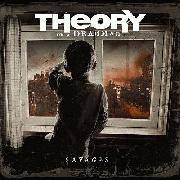
Review Summary: The album does not possess any originality, but what it has can hit the spot. Sometimes.
The Canadian rockers from Theory of a Deadman have never been favorites among enlightened critics and more sophisticated music lovers. “
Nickelback clone”, “spawn of Chad Kroeger’s producing attempts”, “bland and tasteless”, “one of the worst bands of all time” (these are not direct quotes, but close to what you can find on the net) are only some of the epithets directed their way. One can easily imagine that the amount of swill poured on the band would fill a large volume. The question, however, is whether all of this is fair and valid. Let’s try and assess the objectivity of these claims through their third (and most commercially successful) album,
Scars & Souvenirs, released in 2008.
Frankly speaking, some of the comments happen to be valid – for instance, when they’re called a Nickelback clone. While listening to their two previous LPs (as well as this one), the origin of such a comparison is clear. Just like their Canadian compatriots, Theory of a Deadman play standard, even somewhat cookie-cutter, 21st-century hard rock with songs blatantly aimed at radio airplay. The whole of
Scars & Souvenirs is stuffed with conventional yet solidly crafted tracks – be they more aggressive (like
So Happy,
Got It Made,
Sacrifice) or ballad-driven (
Not Meant to Be,
All or Nothing,
Wait for Me) – which can easily end up on the albums of many of their contemporaries without causing any sense of discord. The songs feature a minimal amount of big, simple hooks – just enough to get stuck in the head of an unsuspecting listener while avoiding wearing them out. All of this is wrapped in an envelope of uncomplicated riffs and rhythms that fully correspond with the conservative approach of the bands that broke onto the radio at the turn of the millennium. Theory of a Deadman can be easily included among them, confirming the aforementioned claim of blandness.
“Then how could this album sell over a million copies?” the reader might rightfully ask. The answer seems quite clear and was already touched upon in the previous paragraph. Despite their conventional nature, the songs are executed with a solid understanding of pop music rules, devoid of unnecessary length and lasting only the prerequisite 3-4 minutes. There is yet another aspect: the lyrics. They are simple, easy to understand, and provoke the necessary emotional associations. To be honest, who hasn’t had similar thoughts or impulses in a situation close to the one described in
Little Smirk? Who cannot understand the simple sentimentalities of
Heaven (Little by Little) and
End of the Summer?
Bad Girlfriend doesn’t seem so preposterous, given that there are girls who want to be “bad” and guys who chase after that exact type. It might sound ridiculous, but Theory of a Deadman and their peers all follow the clearly defined rules established in the 1960s by
The Beatles,
The Who,
The Kinks, and others. The only difference between the masters and the students is a complete lack of any innovation. So it is probably wrong to call the poor Canadians one of the worst bands of all time; they are just middle-of-the-road. Which might actually be even worse.
Summing up, it is safe to say that albums like
Scars & Souvenirs have a right to exist. Obviously, they are primarily aimed at unsophisticated listeners or those just starting out on their path to rock music. And indeed, while the album possesses no originality or freshness, what it does have can hit the spot. Such pop-(hard)-rock doesn’t really commit to anything profound.
P.S. Nevertheless, Theory of a Deadman has one trait that allows them to stand out just a little bit. These guys, unlike many of their contemporaries, know how to laugh – even at themselves. Among a swarm of songs full of angst and despair, some humor and tongue-in-cheek charm really help to dilute the sour gloominess.