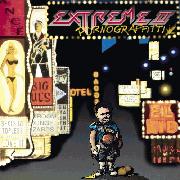
Review Summary: The band releases their second superb LP following the all-around successful Pornograffitti.
With
Pornograffitti Extreme managed to achieve critical acclaim and high sales. Although, in a twist of irony, the double platinum LP became popular mostly thanks to the ballads
More Than Words and
Hole Hearted, which did not reflect the primary sound of the band – funk-infused hard rock. Still, the record deserved such an outcome, since it is easily one of the best efforts in the band’s brief discography. However, Extreme refused to rest on their laurels for too long and soon released a new album,
III Sides to Every Story, which in a way ended up being their most ambitious effort.
Nevertheless, the beginning doesn’t suggest the full scope of their ambitions. At first, after pressing the play button, the unprepared audience will note the thing they came for: that is, confident rock numbers arranged around the always impressive guitars of Nuno Bettencourt and the slightly tongue-in-cheek vocals of Gary Cherone. And they would be right. The first 6 tracks do not indicate anything jaw-dropping, but continue in the vein of
Pornograffitti, although one would note the expanded topical arsenal and an apparent increase in scale. Now they narrate about such topics as war and peace (
Warheads,
Rest in Peace), politics and government (
Politicalamity), racism (
Color Me Blind), and the media (
Cupid’s Dead).
However, as if having summed up their thoughts on the external turmoil that still shakes the world, on the 7th track the album suddenly does a 180 and slows the tempo. Now Extreme switches their focus to love and relationships (
Seven Sundays,
Tragic Comic). This should not come as a surprise, since they gained wide popularity with similarly themed songs, so an attempt to step into the same river for the second time is understandable. However, to our astonishment, the band doesn’t stop there. The next track
Our Father moves to a more somber territory, narrating about a kid who dreams of his father coming back to the family. Two subsequent cuts –
Stop the World and
God Isn’t Dead? – partake in existential introspection, continuing on the topic of a father but in a much broader sense, before the album ends on a grand scale with a 20-minute final track, raising such questions as ‘what is truth?’ and ‘does anybody care about it?’. Obviously, your opinion may vary, but it does seem to be rather profound for a mainstream LP.
Certainly,
III Sides to Every Story is one of those releases that must be listened to in full, from beginning to end, to get the complete picture. The conceptual division into three parts, devoted to external turmoil, inner trials and a desire to find the truth (which, as many of you know, lies somewhere in the middle), requires some time to unfold. However, if you can go the whole way, most likely the outcome will be singular: this musical journey will not leave you indifferent, making you ponder over the various topics presented here. The album finds the band at an unmistakable creative peak, which urges them to expand their musical arsenal to communicate their ambitions. Extreme uses all of the previously employed means for this purpose. As a result, we have excellent guitars from Nuno Bettencourt and great vocals from Gary Cherone; the arrangements are filled with acoustic guitars, piano, orchestral backings, Bettencourt and Cherone duets, and harmony singing from all the bandmembers. And it doesn’t feel overstuffed, as if Extreme adds this or that element just for the sake of it. Quite the opposite, everything is in its place, supporting the intent without any sense of pretentiousness.
In the end, it can be easily stated that
III Sides to Every Story is a univocal success and a major accomplishment for the band, which began its creative career not long ago. In terms of its realization, the album can stand on the same level as
Pornograffitti, while being its nominal opposite: whereas Extreme’s second LP is more a collection of excellent songs, here a full submersion is required (although, it should be acknowledged, these cuts can still function as great singles, it is better to appreciate them within the album context). Unfortunately,
III Sides to Every Story was released at a time when 80s bands were losing on all fronts to alternative rock, so it managed to achieve less popularity than it deserved. However, it is never too late to give the album a spin, as it is worth all the time you might spend on it.