Review Summary: Not as dark as the name hints, but a pleasant listen still.
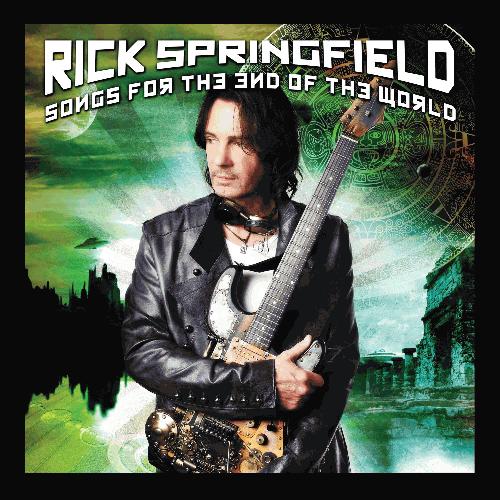
At first the 15th studio album of Rick Springfield, pretentiously and ambitiously named
Songs for the End of the World, makes an ambivalent impression. The Mayan calendar theme, which is hinted upon in the name and the release year, by itself brings thoughts of something apocalyptic, towering, and operatic, akin to [/L]Muse[/L], and – as a minimum – of some storytelling concept. But a sophisticated listener will not find anything of this sort on the album. However, it should not be a reason to give up on this work, which is no less interesting, though for other reasons. Of course, a certain narrative line is present: to one extent or another, almost all songs on the album touch upon specific borderline states of such multifaceted feeling as love, as well as relationships. Presumably, raising feelings to absolute values in this instance can be devastating to the common world, but at the same time, it can open up new dimensions, and that is what music is aimed at, in general and particular. It would appear that this is the idea of the author, who, while doomed, finds (or preserves, despite everything) hope. And tellingly, this is where the album splits into two sides: the lyrics advocate on the Armageddon side and the music is on the side of hope, which resurrects existence. The songs catch the listener’s ear almost immediately, melodic hooks are interspersed all over the LP, and the inner intensity of the album increases progressively as you keep listening to it, reaching its peak in such songs as
My Last Heartbeat,
I Found You and
Depravity.
And the arena-ready
Our Ship’s Sinking may very well be one of the most outstanding (in terms of both musical and lyrical content) examples of this paradoxical dichotomy: the song is about a sink-or-swim situation, and it is up to the narrator to decide, something that he tries to explain to his lover
‘Don’t start thinking you’re going anywhere / Cause I’m not ready to let you go’. It refers to an apparent problem in a relationship that has hit a wall; however, the music and vocals are such that one cannot help but believe the man who hasn’t surrendered to despair.
In the fast-moving
Wide Awake that opens the album is where our narrator apparently appears (it would seem there is only one on the record), awakened by his muse, torn by inconsistencies, but pushing forward (
Trying to wake up from this nightmare screaming / You showed me my mistake).
Be it the simple, but very rock ‘n’ roll, and introspective
I Hate Myself or the straightforward ballad-y
You & Me, the message and thoughts of the main character are simultaneously addressed to himself and idyllic love union. Somewhat apart, although only at first, would seem to be
Gabriel with its obvious religious focus (does Springfield hope for the good news, singing ‘
Oh, Gabriel, I can hear you whispering’?), but given the impending end of days, the chances to turn to faith increase.
There is also an address to extraterrestrial civilizations (
A Sign of Life), or maybe again to a certain female. And if we view this cut as being the central one on the album, then its music contends to be the strongest song in its composition (intro, verse, acceleration, pulsating chorus, and so forth). At the same time, using the same considerations and without any doubt, we can put
Joshua next to it, even though it’s less catchy and softer in its presentation but follows the genre canon. Also worth mentioning is
My Last Heartbeat, an example of a well-thought-out rock song, which combines the restless and intense swiftness of the verses and epic choruses with its popping guitar; you can easily imagine the character going through a deserted city of eternal lights that he sings about.
I Found You with its apocalyptic atmosphere is a standout too – a dark ballad, and the best one on the album, and its chorus is of a similar edge to
Alter Bridge, especially if you make the sound heavier.
The LP ends with a deceptively accelerating
One Way Street, a song cut in the best tradition of
Bruce Springsteen and his E Street Band that seems to try and sum up one of the topics permeating the record – the failure of people to communicate and the hope of overcoming this (
Hoping and praying it’s true / That love is never a one way street).
As a result, we get a very solid recording which, though it stays within genre boundaries, is diverse, melodic, and well-polished, with heart and passion put into it. The album, despite the abovementioned lack of concept or originality, is consistent, without any sagging in the beginning or the end, winding down only in places where the logic of a pop-rock recording requires it.