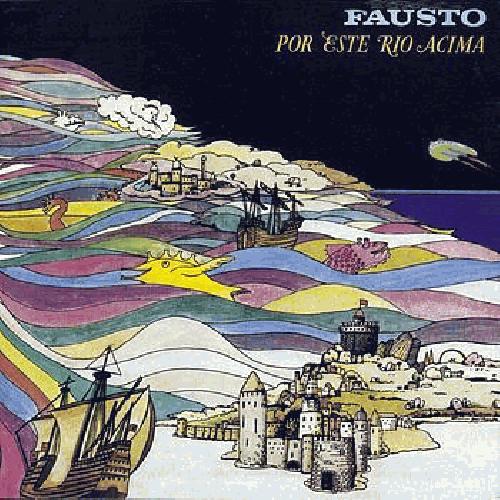
Review Summary: Nautical sense.
As an avid music listener, I had a period of fascination with concept albums back when I was a teen. I used to be eager for everything from the bombastic metal operas of Avantasia and Aina to the headier stuff. In time, however, I’ve realized that the concept beyond an album is not a priority. If a songwriter uses a concept or a story as a vehicle to create some good songs, that’s fine by me. But what’s important first and foremost is the quality of the music.
Besides, I just don’t speak Portuguese. So, in reviewing this album composed by Portuguese singer and multi-instrumentalist Fausto, I am going to focus on the music that he offers, and not on the story he is trying to tell in his lyrics. It deals with the sea and with maritime discoveries and adventures. Let’s get on with it.
The album opens with a short yet sprawling intro, “E O Mar Que Nos Chama,” which is actually a good representation of the album as a whole. It opens with a beautiful guitar melody that is used as a foundation to which various flourishes are added, such as symphonic elements, flutes, mandolins, and various other instruments. In fact, the only thing that is not present on the album is the brass section. Otherwise, you have it all. Even the accordion makes a substantial appearance on “De Um Miseravel Naufragio Que Passamos.”
Similarly, the first two “full” songs give you a very clear idea of what you will hear further on. “O Barco Vai De Saida” with its simple but not simplistic guitar licks and wonderful if brief flute sections tells you everything you need to know about the faster tracks of the album. In turn, “Porque Nao Ne Ves” shows you how the slower tracks will sound.
Therein lies one of the few issues that I have with the album. For every fast song, the pattern is essentially the same: the guitar parts are restricted to simple and quite similar licks that don’t really develop throughout the songs, instead serving as a mere backbone for other instruments. Normally, there are also some claps and gang vocals, which I am not a fan of. So, the fast songs here tend to blend in a little bit.
Mostly, I find the slower numbers to be the true gems here, like the abovementioned “Porque Nao Ne Ves.” Its arrangement is quite rich, and the guitar work is much more inventive and versatile than on the preceding track. The very nice psychedelic vibe of this song is reinforced by the pensive guitar and dreamy vocals. The best part comes toward the end, when the guitar speeds up gradually without reaching the breakneck speed. If you listen closely, you’ll notice how the guitars and the drums support each other, changing and morphing together with the song. And it’s not even the best “slow” song on display here! I myself am especially pleased with “Como Un Sonho Acordado,” which treats your ears with delightfully spooky violins, and “O Cortejo dos Penitentes” with a similar Halloweenish vibe. Yes, "Por Este Rio Acima" can actually be a good Halloween album!
However, one must not disregard the faster tracks as well. The good news is that despite some similarity of the guitar parts, they all actually work. “Navegar Navegar” is the simplest of the bunch in terms of arrangement, but it is still a fun and engaging song. Every other track here is enriched with various instruments. The flute is exceptionally great throughout the album, as are the symphonic parts. As I mentioned, one of the songs is based around an accordion melody, while “A Voar Por Cima Das Aguas” utilizes a mandolin, and Fausto also experiments with faster vocals here. Finally, I have to pay special attention to “O Romance De Diogo Soares,” which is one of my favorite tracks on the album overall. It has probably the best flute parts, wonderful female vocals, and feels like a soundtrack to old adventure movies.
However, the album is strong and consistent throughout its runtime, and even the weaker songs here are very well made. They all have some extra factor that differentiates them from the bunch. The album is also reasonably well sequenced, with the tracks grouped in such a way that they gradually uncover different moods and aspects of the whole body of work.
I would also like to emphasize that the closing tracks on the album are just as strong as the opening ones, if not stronger. The solemn “O Que A Vida Me Deu” is followed by “Lembra-Me Um Sonho Lindo,” which is probably the most emotional and dramatic song on the whole album. If you don’t have time for a big concept album about the sea, I would urge you to give a listen to at least that one beautiful composition. And then, the closing “Quando As Vezes Ponho Diante Dos Olhos” comes in, and it may feel redundant at first. Didn’t we have enough beautiful ballads already? But wait a little bit, and the song opens up quite nicely, especially in its second half, when the piano comes along and engages in an interesting interplay with the other instruments.
To sum up, while the album requires attentive listening, it is not excessively heady. You don’t have to force yourself to re-listen for gazillion times until it finally clicks. I myself singled out some favorite tracks on my first listen and felt fully connected on the second or third one. It is sad that beautiful and unique music like this does not get enough appreciation due to the language barrier or lack of exposure to a wider audience. Please, consider giving it a chance.