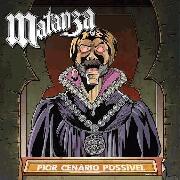
Review Summary: While you're there stirring trouble; I keep sharpening my art of insult.
Oh, dear reader...
I feel sorry for you — a non-Portuguese speaker — who will never be able to fully appreciate all the poetry contained in Matanza’s candid lyrics. Some things simply do not survive translation: the insult delivered at exactly the right moment, the perfect choice of the wrong word, the art of calling someone an idiot with aesthetic conviction.
A Arte do Insulto (The Art of Insult) makes this clear in the very first second. Literally the first second. There is no introduction, no warm-up, no context. The album opens with a verbal flying kick so precise it works almost like a linguistic manifesto: here, Portuguese is not a language — it’s a bladed weapon.
Doubt it? Let me help you by translating the opening lines of A Arte do Insulto (the song):
"Not bad for a fool
Mentally slow,
You wanted so much to be the guy
Known among the biggest idiots
Very well, you have
The talent that makes you
Such a prominent jerk
One of those not commonly seen"
The title track doesn’t introduce the album; it imposes it. Before the listener can even adjust the volume, Matanza makes it clear that subtlety is not on the menu. The insult is not gratuitous — it is method, language, and identity. From this inaugural aggression, the album is built: a parade of characters, twisted moral codes, epic drinking sessions, and truths delivered with no civilizing varnish whatsoever.
And that’s where The Art of Insult, Matanza’s fourth studio album, released in 2006, truly begins. Heavier, drier, and more aggressive than its predecessors, the record eases off the countrycore and stomps hard into heavy metal and hardcore punk. Direct riffs, brutal pacing, and lyrics that don’t ask to be understood.
From here on, this is no longer just about music — it’s about posture. Matanza doesn’t want to be understood; it wants to be heard. Loud. Preferably with a drink in hand and very little patience for humanity.
The entire band is on fire and here Jimmy London solidifies for good his character (which is nothing but Bruno London on steroids).
Eu Não Gosto de Ninguém (I Don’t Like Anyone) is one of the most honest confessions in Matanza’s entire discography — and that says a lot. It works as an anti-social anthem: direct, short, and absolutely uncompromising. Everyone has thought this at some point; Matanza simply had the courage (and the lack of manners) to sing it.
Quem Perde Sai (Loser Gets Out) operates almost like a crooked moral code within the album’s universe. The logic is simple, direct, and merciless: there is no room for victimhood, explanations, or redemption. You lost? Get out. The song carries a nearly sporting sense of brutality — competitive, harsh, and completely devoid of sentimentality.
Tempo Ruim (Bad Time) is an outlier — and precisely for that reason, it stands out. Here, Donida and Jimmy expand their emotional palette and deliver a surprisingly beautiful set of lyrics. It speaks of separation, farewell, struggle, and the sincere hope that, despite everything, things will turn out fine. Over time, the song gained an almost prophetic weight within the band’s discography. Not coincidentally, it was the final song played at every show on Matanza’s farewell tour about ten years ago. Ending their own story with “Bad Weather” wasn’t just a setlist choice — it was a final statement. A tired, honest, and unexpectedly human gesture.
As for Estamos Todos Bêbados (We’re All Drunk”) well, forget any drinking song you’ve ever heard in your life. Nothing compares to this pirate anthem for the world’s alcoholics. The song works as a collective chorus of degeneration: no one points fingers because everyone is equally guilty.
Finally, A Arte do Insulto also contains the most popular song in Matanza’s discography, "Clube dos Canalhas (Club of Scoundrels). Curiously, I’ve never fully understood that status. It’s not the sharpest lyric on the album, and the song seems to drag more than it should. Still, it became a symbol — perhaps less for its composition and more for the spirit it carries.
What spirit would that be? I have no idea.
But throughout the record, Matanza turns absurd stories into a narrative method. Nothing is subtle, nothing is elegant — and that’s exactly why it works. The humor is filthy, the cynicism is fully embraced.
Maybe that’s why A Arte do Insulto has aged so well. It doesn’t rely on context, trends, or era. It’s an album that understands not every piece of music needs to uplift, teach, or save. Some exist simply to laugh at the chaos, toast to failure, and accept that sometimes the weather will stay bad… and that’s fine.
“While you're there stirring trouble
I keep sharpening my art of insult”