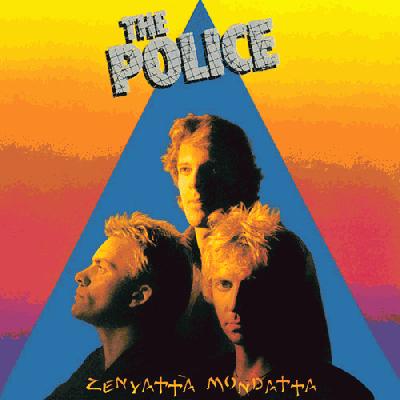
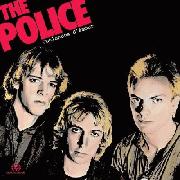
Review Summary: Their finest album yet, Zenyatta Mondatta is the result of superior musicianship meeting focused songwriting.
The Police Discography
Part 3: Zenyatta Mondatta – The Maturation process is achieved.
There is a relevant storyline weaving through the history of the Police’s first three albums. Aside from brandishing absurdly pretentious titles, the trio of records provides an effective study of the musical maturation process from both an instrumental and songwriting scope, and the hard fought battle to interweave the concepts. The Police are widely regarded as elite musicians inside the New Wave/80’s pop era, and the instrumental chops displayed on debut “Outlandos d’Amour” and follow up “Reggatta De Blanc” were impressive, even outside their panned-by-elitists genre. Although the playing of guitarist Andy Summers, bassist/supreme ego Sting, and syncopation master/drummer Stewart Copeland on their first two records was virtuosic, the most effective, lasting, and gripping tracks were layered more in simplicity than artistic wankery. In short, the Police knew damn well how to play their instruments, but their writing suffered when artistic pretension and experimentation overruled simplicity, hooks, and structure. The maturation process, or in the case of The Police, the ability to successfully meld musical experimentation with effective, focused songwriting would not realize its full potential until the release of their third album, 1980’s “Zenyatta Mondatta.”
“Zenyatta Mondatta” is neither the Police’s masterwork nor their most immediately accessible record, but the collision of instrumental improvement and a heightened clarity towards streamlined songwriting provided the foundation for their most mature effort to date. Virtually every musical sensibility is improved, and more importantly “Zenyatta Mondatta” pays heed to consistent structures, redeeming the dire lack of focus that plagued “Regatta De Blanc” and to a lesser extent, “Outlandos d’Amour.” Expounding upon heightened musical sensibilities, the record also relishes a substantial change in direction, supplanting the dominating faux punk/reggae feel of previous works with greater emphasis on pop, jazz, and Middle Eastern influences. Perhaps searching for enhanced credibility, another glaring positive in relation to the maturity process is “Zenyatta Mondatta” is far superior lyrically, and is not burdened from the disastrous inclusion of “joke” tracks like “On Any Other Day” or “Be My Girl Sally,” two of the most dire ideas of the modern pop era that tarnished the overall legacy of their previous two albums.
Although The Police are tight as a unit, the nature of “Zenyatta Mondatta” is enhanced by strong individual performances. Immediately noticeable is the heightened presence of Summers, who cashes the most consistently gripping and melodic showing of his career. Whereas Summers was often relegated to background player in the past, his jumpy, ringing guitar carries tracks like the ska-catchy “Canary in a Coalmine” and the infectious “Man in a Suitcase,” while a newfound emphasis on passionate soloing adds an atmospheric, spacey feel to the record as an entity. Expounding upon the echoing layers of Summer’s guitar, the rhythm work of Copeland is as stalwart and forceful as ever, and his songwriting on the Talking Heads-esque “Bombs Away” is a vast improvement from previous entries. Although Copeland’s knack for mastering drilling, effectively sporadic rhythms is near legendary, his greatest asset was an effective partnership with Sting in supplying penetrating grooves, the foundation to every lasting Police song.
The presence of, and more glaringly, the evolution of Sting is the dominating aspect of “Zenyatta Mondatta,” whose memorable, pulsating bass grooves and improved lyrical storylines are the culminating aspects of the record. While the hauntingly infectious “Don’t Stand So Close to Me” is a timeless Police pop song, its harrowing lyrical content shows Sting branching into untested boundaries, adding a legitimacy missing on previous efforts. Three of the record’s most memorable tracks, “Driven to Tears,” “When the World is Running Down,” and “De Do Do Do De Da Da Da” showcase his first delving into political writing, while each entry is categorically driven by snaking, hypnotic bass. While the majority of Sting’s efforts here are clinics in modern pop songwriting, the striking presence of memorable bass salvages otherwise average tracks like “Voices in My Head” and “Shadows in the Rain,” cutting down the percentage of filler that had become standard to this point. Finally, from a unity perspective, while the soundtrack to many a cheesy 80’s video game is conjured up by “Behind My Camel” and a sparse few other moments are subpar, the majority of “Zenyatta Mondatta” is the pinnacle of what the Police had achieved thus far.
The lasting impression of “Zenyatta Mondatta” is the effective melding of pop sensibilities with above average instrumentation, or more simply, the sound of a talented band rounding into form. While the record is often panned by the band itself for being rushed to production, it is an important piece in Police history. Unlike other Police albums, the legacy of “Zenyatta Mondatta” is not measured by record sales or the presence of a signature, watershed song. The most encapsulating, triumphant aspect of the album is the maturation it achieved, and the groundwork it would lay to their impending masterpiece.
Recommended Tracks
Don’t Stand So Close To Me
De Do Do Do De Da Da Da
Driven to Tears
Man in a Suitcase
When the World is Running Down