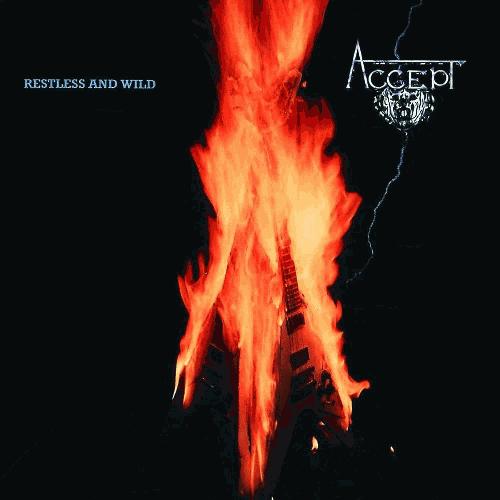
Review Summary: A few rough edges on a heavy metal landmark
Accept give you just enough time to wonder whether you have put on the wrong record. A cheerful German folk tune crackles away, the needle scratches, and Udo Dirkschneider lets out a scream that puts an end to the pleasantries.
Fast as a Shark still makes a tremendous entrance. Stefan Kaufmann’s double-bass drumming and the tightly clipped riffing hurtle towards a lead section whose melodic precision seems almost improbable at that pace. In 1982, this was an early speed-metal milestone, pointing towards the aggression that thrash would soon develop further. Decades later, its excitement needs little historical explanation. It also sets a standard that
Restless and Wild spends much of its running time trying, with varying success, to match.
The record’s everyday business is less frantic. Accept remain attached to the swing and direct appeal of hard rock, favouring sturdy riffs, emphatic choruses and a generous helping of swagger. The title track’s gallop has an irresistible physical pull, while the backing voices turn its defiance into something you want to join, preferably with a fist in the air. Dirkschneider is the signatory of that invitation. His rasp gives even the most elementary lines a belligerent conviction, and the shrieks arrive with enough force and conviction to make the occasional lyrical absurdity easy to forgive. Peter Baltes and Kaufmann keep the songs moving with a solidity that allows the guitar to roam. There is plenty of discipline behind the racket, and a good deal of fun.
At times, however, the band seems satisfied to find an appealing riff and leave most of the writing there. The bounce of
Get Ready and the AC/DC-like strut of
Don’t Go Stealing My Soul Away are enjoyable enough, but they offer modest rewards beside the opener’s concentrated fury. I have no objection to a metal record loosening its collar. The difficulty comes when an obvious hook is expected to carry a song farther than it comfortably can.
Shake Your Heads pushes the audience-participation routine towards cliché, and some of the repeated choruses elsewhere could have used another idea between them. These songs help explain the album’s jaggedness, though their enthusiasm generally keeps them from becoming dead weight.
Wolf Hoffmann frequently supplies the extra interest. Having played all the guitar parts on the finished recording, he gives its layered harmonies an impressive clarity, with a classical sense of melody that can lift an otherwise ordinary material. I especially admire how the lead work broadens the mood without weakening the riffs beneath it. The elegance of the harmonised passages and the vigour of his attack belong together, and the solos often provide melodies as memorable as the vocal lines. That makes his less focused moments more frustrating. A few stretches of tremolo-bar excess sound like opportunities squandered by a player capable of much more expressive phrasing. They are brief lapses, but the surrounding work sets a high standard.
When the band decides to spread out their arrangements, they make the best use of that talent.
Neon Nights moves from its delicate opening into a performance full of stops, changes in guitar texture and shifts in Udo’s delivery. Its melancholy gives the album some welcome emotional depth, while the grander melodies of
Princess of the Dawn suggest the fantasy and scale of Rainbow. These passages show a band able to create drama at a measured pace. The latter song is particularly persuasive in its use of repetition: its persistent central riff sprinkles enough fairy dust and anticipation to sustain the unfolding scene. For me, that is precisely what some of the shorter rockers lack. Unfortunately, the sudden cutoff denies the closer a satisfying resolution. After all that patient accumulation, it feels as though Accept simply ran out of an ending.
The recording gives these divergences room to register. Its rough guitar texture and substantial midrange suit the music’s muscular character, while the drums have enough definition to preserve the force of Kaufmann’s playing. There is an occasional scratchiness in the quieter passages, but the overall sound remains involving. The chugging rhythms, group vocals and interlocking leads feel close enough to enjoy individually without losing the impact of the band as a whole. It is a fitting setting for performances that can be meticulous one moment and cheerfully excessive the next.
I understand why
Restless and Wild attracts such an unqualified affection, though. Its finest songs are extraordinary, and the personalities behind them are audible even when the writing settles into familiar habits. I cannot quite extend that praise to every composition, nor does the album’s importance make its lesser moments disappear. Still, its imperfections leave me with far more to enjoy than to excuse. Accept had found a formidable sound, and the combination of Hoffmann’s melodic imagination, Udo’s abrasive presence and those rousing choruses remains enormously appealing. Its place in metal history is secure. The urge to turn it up is what keeps it in my rotation.
Recommended tracks:
Fast as a Shark
Neon Nights
Don't Go Stealing My Soul Away
Princess of the Dawn