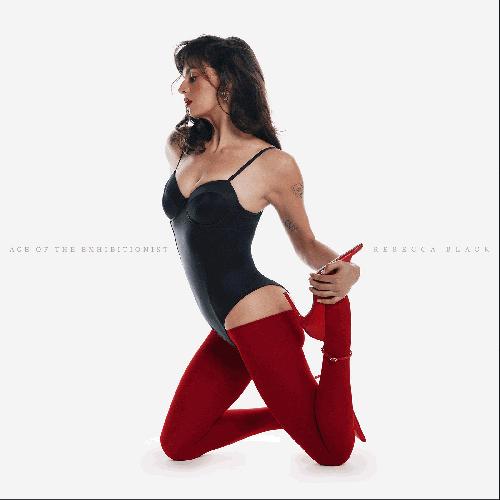
Review Summary: Everybody wants a show.
The story of Rebecca Black has to be one of the most fascinating in modern pop music. I’ll spare the details since I’m sure everybody is well aware of her viral beginnings – that is, unless you were living under a rock in the early 2010s. For those who haven’t been paying attention since those days, I’ll be the one to inform you:
Friday was a very long time ago, and Rebecca Black has since carved out a name for herself in pop music, even if her work has yet to truly break through in the mainstream. Part of that may be because her previous work leaned a bit more in the hyperpop direction, which isn’t always the most accessible subgenre of pop. With
Age of the Exhibitionist, though, Black appears to make strides towards establishing a more conventional pop sound while still occasionally showing her roots in hyperpop. While I feel this transition in styles has partially led to Black losing a bit of the identity she had established on prior releases, the album is still a resounding success and is more than enough to prove that Rebecca Black has the creative chops to stand toe to toe with today’s biggest pop stars.
As
Age of the Exhibitionist’s title may suggest, lust and sexuality are the primary themes of the album, and Black does very little to try and hide that from the listener. These themes are as abundant as ever on tracks like
Exhibitionism, which features on-the-nose lyrics such as, “Can you go where nobody goes? / Begging you to come over and lay me down / The windows wide open, the neighbors are hoping / To catch a glimpse of me on the wall.” I would imagine that, if you’re one of those aforementioned people who haven’t been paying attention to Rebecca Black’s more recent, serious forays into pop music, these lyrical themes may catch you quite a bit off guard. However, Black delivers these lyrics with the necessary confidence and conviction to spare lines such as these from being cringe-inducing. I won’t lie to you and say that the themes are never tiring (some lines made me roll my eyes, such as “I’m ex-bicurious, now I’m try-sexual” from
Speakerphone), but the instances that cross this line are few and far between and never detract from my overall enjoyment of the album.
As alluded to before,
Age of the Exhibitionist sounds like a very noticeable attempt to break into the mainstream. In fact, I wouldn’t even classify this album as hyperpop; it’s more of a dance-pop album with dashes of R&B, akin to Ariana Grande. Songs like
Exhibitionism and
Pistol feature silky-smooth, melodic choruses that contemporary R&B is known for. Both of these songs are highlights on the album despite their stylistic differences from Black’s past.
Anaheim Girl and
Speakerphone have an undeniably infectious nature to them as well due to their unique marching beats, and both songs feel reminiscent of 2000s pop hits like
Hollaback Girl. However, the album comes with a few duds that sadly don’t do enough to stand out from the rest.
Corsetry and
Michael are, to put it bluntly, boring attempts to slow things down, and neither has anything particularly memorable to warrant repeated listens. Songs like these made me yearn for
SALVATION, which never took its foot off the gas pedal even for a second. The more conventional approach on
Age of the Exhibitionist isn’t inherently an issue, as the album highlights more than prove. But the weaker tracks expose what happens when you remove the bombast and eccentricity of her previous work without replacing it with something equally captivating. For those who still want a taste of Rebecca Black’s hyperpop sensibilities, look no further than
Miss Delicious, which is by far the most hectic yet urgent song on
Age of the Exhibitionist. Its lyrics are incredibly silly, but when the beat is this good, who cares?
Regardless of how you may feel about Rebecca Black’s modern musical endeavors, the woman has displayed an immense amount of courage and confidence throughout the last decade and a half. After being the butt of the joke for the entire internet (as a teenager, no less), she could’ve easily avoided the spotlight like the plague going into adulthood. Likewise, she could’ve banked on the infamy of
Friday and remained some kind of gimmick act this entire time. Yet she chose neither of these options and has instead confidently planted her flag in the modern pop scene.
Age of the Exhibitionist is some of Black’s finest work to date, even if it lacks some of the more unique qualities that her past work had. If this is the album to launch her career towards wider recognition and acclaim, she’ll have earned every bit of the success.
3.75 out of 5