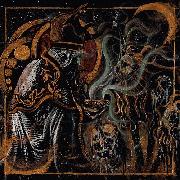
Review Summary: Progressive rock, Brazilian style
Modern progressive rock and metal often try too hard to seem overly complex and genre-bending, sounding as if the musicians' heads swelled with the realization of their own genius during recording. However, the Brazilian quintet
Papangu, hailing from João Pessoa, couldn't care less about such conventions. Effortlessly, they blend avant-garde prog rock, jazz-fusion, and neoclassical music, all while utilizing a thoroughly unconventional... well... noise inventory. How about Brazilian folk chants and a full-fledged rubber chicken solo?
Returning with their third album,
Celestial, the band once again proves themselves to be shape-shifting chameleons, reinforcing their reputation as masters of form, approach, and style, capable of masterfully juggling the legacy of
Yes,
Camel, and classic progressive rock. Within their music, multiple forces coexist and remain in constant struggle, generating inevitable contradictions between harmony and dissonance, melody, density, and expansiveness.
Celestial lives up to its name, shining dazzlingly like the sun or the stars.
Here, vocals are deliberately pushed into the background, yielding the stage to pure instrumental virtuosity. The band tackles the task of telling stories without words through texture work. The spotlight falls on warm, bold vintage synthesizers whose sound evokes the golden era of Yes, while deftly avoiding cliché homage. Melodies in tracks like
Colosso and
Mau-Olhado ring out with an almost resort-like carelessness, whereas
Taxidermia dissolves into refined dissonance, fusing guitars and keyboards into a monolithic flow. At the same time, the album is entirely devoid of academic sterility: the classical piano in
Celeste acquires an unexpected edge thanks to drummer Vitor Alves and his jagged tom hits, while on
Fechamento de Corpo, the bass and synths engage in a deeply natural dialogue. The music here becomes literally physical – structures flow seamlessly from one state to another, and on the track
Afirmação, they even break into a dance to traditional Brazilian forró and ciranda rhythms.
Such plasticity of form would be impossible without the musicians' core stance: a total rejection of digital compromises.
Celestial was recorded entirely using analog equipment to achieve an authentic vintage sound multiplied by modern technical precision. Thanks to this, the intricate transitions in tracks like
Taxidermia retain crystal-clear legibility, and
Bode Expiatório smoothly navigates refined jazz harmonies before resolving into a grand cosmic finale. Rodolfo Salgueiro’s sparse vocal interventions – sharp shouts in
Mau-Olhado or
Iamanakaru – never pull attention away, instead weaving into the album's overall fabric as naturally as a river’s waters flow and bend through the Brazilian mountains.
Celestial masterfully juggles geographical markers and classic prog rock, avoiding the fate of over-intellectualized and cold pretension. Behind the deceptive sunny lightness and accessibility lies a multi-layered concept that demands the listener's full immersion and repeated spins. Almost no traces of the band's metal past remain here – only occasional blast beats flashing beneath jazz rhythms and psychedelic shouts echoing the late sixties. Compared to their previous work, the compositions are shorter and more concise, approaching the elegance of
Caravan and Camel while retaining technical complexity and avant-garde audacity.
Celestial is a strange, dazzlingly bright, and impeccably constructed world where vintage academicism sits side-by-side with the absurdity of a rubber chicken. But most importantly, it is utterly impossible to tear yourself away from it.