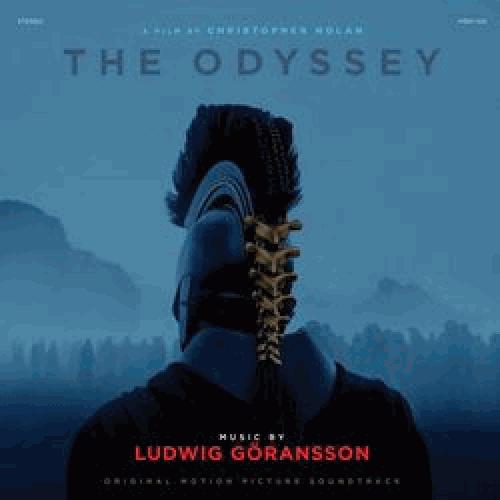
Review Summary: A bone-chilling accompaniment tethered to bronze, reeded instruments, claves, choirs and lyres, further modulated with a modern palate to create a bespoke, mythic world unto itself.
The central motif of the Siren song was so haunting that I even dreamt about it on the same night I first heard it. I just couldn't get it's muted, double-reeded, polyphonic, aulos flute out of my head even in my sleep, with the way it whirls back and forth in a scene that should otherwise exemplify the stilted nature of the movie's pacing, but just doesn’t, but for this dissonant, droning chord progression piercing through the blanket of earplugged silence as Matt Damon squeals like one of Circe’s pigs in her Orkney pork stew café.
Not only does this motif add existential angst to when we first hear it, but even moreso to enhance the final act of the movie, in fleshing out the emotive parallels Odysseus feels inside of himself. That being, the sonic embodiment of being beholden to the desire of the thing he wants the most, that then builds and builds like an unbearable itch, in a scene in which he is describing the full extent of his trauma as a confession disguised as a beggar, to the love of his life Penelope, obscured by nothing but a thatching of wood and Athena’s spirit slipping out of his grasp. So much hangs in the balance in this preface of the final act, and it is emotionally and texturally tied as much to the sonic ambition, as it is to the choreography and cinematography, starting with nothing but this simple monologue, and this aulos. Then, the ensuing climax of the movie has it's gravity felt in the same soundscape. As the tempo increases, so too does the instrumentation steadily bulge under its own weight, as Odysseus bites off more than he can chew, surrounded by insurmountable pressure, once again letting his own mortality to be fumbled into an aegis of blood and bronze. The payoff is so primally felt because of how the two run in tandem.
This is just one example from many, of how the film's score acts as a lynchpin in every emotional peak in the movie, which the movie itself couldn't portray, not least of all because of Nolan's penchant for exposition-heavy dialogue and somewhat robotic characterization.
Case in point, the music overlaying the flashback of Troy, plods perfectly to exemplify the tension of them being crammed and seemingly resolved into a coffin of bronze, and as the sequencing unfolds, the music churns from a steady tapping, to a stamping of a heart pulsing with adrenaline, wracking every moment with more and more urgency, a tribalistic howl being punctuated all the while before the act culminates in the barging of the stronghold and the full brunt of the siege is realized. Nolan here then perfects his tightrope walk of retelling a story as both mythic and archetypal, but also grounded with some level of realism, with Agamemnon crowning a less than diminutive mudslop adobe gate wearing an obsidian husk, like he’s on a Louis Vuitton sponsored catwalk retold in the ancient past. I can’t help but feel this synchronizing of sound and scene, and the sequencing of these motifs, is as symbiotic of a relationship as you can get, and is surely one of the best ever examples put to film.
Similarly, what stands out in this score again and again, is the perfect cinematic layering, the ebbing and flowing of tension, and the sound design and instrumentation that sounds equal parts modern as it does archaic. Of many highlights, the song dedicated to Circe, features an eerie aural fabric that mirrors the foul transformation of flesh seen in the movie as she sculpts man into pig.
Laestrygonians offers another rendition of barrelling tension, with bronze slabs getting plonked, reeded instruments whistling through an underbelly of percussion, with every possible tenor of vocal, even that of James Blake, conveying once again, the sheer drama of giant silver gilded bastards skewering smaller bastards- something which would otherwise appear Monty Python-esque.
Cyclops channels the sheer incomprehensible Lovecraftian horror of its title, with a jagged brass tinged synth squelching an intermittent bell alarm in the dead silence of its cave to the extent that you can see the scene just as you hear it.
The clanging of claves, endless humming of random blokes and seemingly, the wailing of witches in wigwams, and moreover, the general clobbering of untold instruments, make sure that every moment has something texturally close to the world that’s being portrayed. And yet there are the trademark Zimmer-esque freight ship horns, padded bass bonks and buzzsaw synths like that in the song
Hades, that bastardize it into an alienating bronze age darkwave Frankenstein beast of it’s own. It shouldn’t work, yet because of the mastery of Ludwig Goransson, it just does. In closing, I can’t even begin to imagine a soundtrack more effective in fastening such a sonic sail to the hull of Nolan’s ship, so that even Travis Scott calunking his staff and jabbering some nonsense sounds perfectly thematically in place (the less said about dactylic hexamater the better). Such is the emphasis of the soundscape, that if you watch the movie once, on relistening to the score, you will relive the scenes exactly as they were choreographed in a vivid synesthetic way. And yet it is more than just an accompaniment, but it’s own meticulously engineered masterwork.