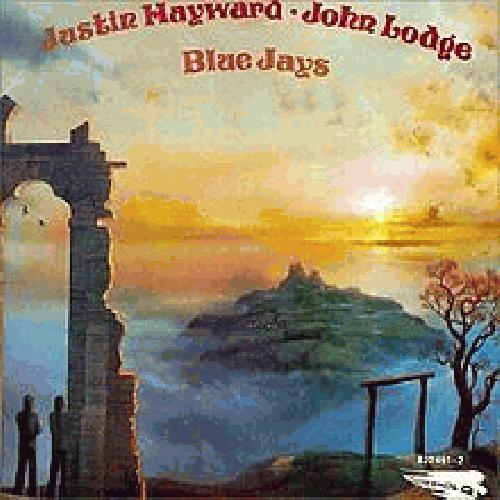
Review Summary: Is this The Moody Blues’ missing piece? I don’t know but it’s a great work.
“Blue Jays” is the only studio album of Justin Hayward and John Lodge, two of The Moody Blues’ members. It was recorded in 1974 and released in 1975. The line up on the album is Justin Hayward and John Lodge. The album also had the participation of Jim Cockney, Kirk Duncan, Tom Tompkins, Tim Tompkins, Graham Deakin, Mark Singer and Del Newman on the orchestral arrangements.
“Blue Jays” was recorded and released during The Moody Blues’ hiatus of five years. Between 1972 and 1978, after the release of their eighth studio album “Seventh Sojourn” and before the release of “Octave”, The Moody Blues took a break from recording together and the band’s members improved to release some of their solo albums. During that time, the members of Moody Blues felt the need to emulate Yes, and release solo albums, too. So, Hayward and Lodge released “Blue Jays”, Mike Pinder released “The Promise”, Ray Thomas collaborated on two projects, “From Mighty Oaks” and “Hopes, Wishes And Dreams” and Graem Edge produced two collaborating albums, “Kick Off Your Muddy Boots” and “Paradise Ballroom”. Meanwhile, Hayward composed “Songwriter” and Lodge “Natural Avenue”.
So, and as I told before, it was in this context that Hayward and Lodge joined together and released “Blue Jays”. The album had originally been a project of Hayward and Pinder but as soon as Pinder left, Lodge entered. For many people “Blue Jays” is the missing link between “Seventh Sojourn” and “Octave”. And in reality, despite the absence of the other three band’s members, it has all the distinctive marks of an album released by the band. So and in a certain way, “Blue Jays” can be considered the lost album of The Moody Blues, the album that The Moody Blues never made. It has all the hallmarks of a band’s album, with Hayward’s distinctive vocals and his guitar work, perfect harmonies, strong melodies, and even orchestration by Peter Knight, who had first worked with the band on “Days Of Future Passed”. At least in terms of sound, Hayward and Lodge have created with “Blue Jays” the ultimate The Moody Blues’ album. It has the same sound that established the band’s mass popularity in 1968 with their album “Days Of Future Passed”. Basic rock instrumentation heavily overlaid with Mellotron or string orchestra, and the vocals treated as instruments in the Wagnerian manner. In strictly musical terms, however, The Moody Blues are far from Wagnerian. Simple and melodic themes are elongated to accommodate a dramatic and emotional swelling orchestration and a gargantuan crescendo.
The album opens with a fantastic track, “This Morning”. It’s an amazing track and the album is worth buying solely for it. It’s one of the best songs on the album and one of the best compositions of Hayward. But there are other great songs too, like “Saved By The Music”, “I Dreamed Last Night” and “Maybe”. “Saved By The Music” has a lovely, memorable melody, and the way the song accelerates towards the chorus each time through is absolutely wonderful. Meanwhile, “I Dreamed Last Night” is simply fantastic. The string arrangements truly carry the song to a new level, the melody rules, and the middle section is soaring and gorgeous without going overboard. “Maybe” simply is another song superiorly orchestrated. It’s a song with a beautiful melody and good instrumentation. This is my favourite Lodge song on the album. But of course there are a few weaker songs, too. But I still enjoy them. For instance, “Remember Me (My Friend)” is a solid anthem of brotherly love, and overall, it works just fine. And the chorus is nice too. There’s also Lodge’s written “You” which sounds closer to country than anything the group had done up to that point. Anyway, this is nice, though. Lodge makes it sound so sincere, and once again the chorus is solid and well written. It’s not bad.
The CD version of “Blue Jays” has a bonus track, “Blue Guitar”. It was originally released as a non-album’s single. But the version on the CD is different. It was performed by Hayward with the band 10cc and was added upon its re-release. It’s a short track with nice and melodic guitar work. But in fact, it has nothing to do with the rest of the album.
Conclusion: “Blue Jays” is a great album. It’s the most romantic and the most successful album released by any The Moody Blues’ members in their hiatus. I’m not sure if “Blue Jays” is the lost The Moody Blues’ album. But I’m sure that “Blue Jays” proves three things. First, if this album had been released by the group it would be one of their good works. Second, once again it was demonstrated how good this duo of composers is. Third, how a simple musical work can be a great work served by a superior orchestration. The harmonies are probably the most notable characteristic of the songs on this album. Hayward and Lodge have always harmonized well and those harmonies are exploited for full effect on this album too. These two artists are masters of mellow rock. “Blue Jays” may not be a masterpiece, but it still is a good work. In fact, if you are looking for simple music with a touch of prog, turn out the lights and listen to this.
Music was my first love.
John Miles (Rebel)