|
| |
|
|
|
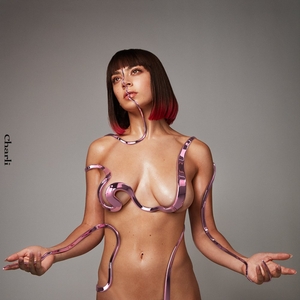
Review Summary: The motherfucking future Charli is a roller coaster of an album, complete with build-ups, payoffs, stomach-churning loops, and breakneck stretches, all of which may invoke fear and exhilaration at different turns. And at the front seat is Charli XCX herself, utterly unafraid to lead the charge. She has designed every twist and turn of this ride, and is more than happy to usher along fans and newcomers alike in her wake. Though still entrenched firmly in pop, Charli is light years away from the sounds of her previous two albums. That fact alone illustrates her oft reiterated point about pop being the diverse, volatile genre that it is. But Charli XCX doesn’t need comparisons to her previous work to prove it; all she needs is Charli, her most sonically eclectic, emotionally rich, and ultimately satisfying album yet. (And yes, that includes—because it should—her mixtapes.) Throughout its course, Charli XCX uses pop as a means to capture the extreme ends of sound and feeling.
Charli XCX considers this to be her most personal record, so it’s telling that she brings idea of the party front and center with “Next Level Charli.” Rather than view the party as the decadent means of escapism it’s often treated as in contemporary pop and R&B, she treats it like a religious experience, repeating her verses like they’re meditative chants. “I go hard, I go fast / And I never look back,” she nearly shouts. Suddenly, partying is a way to get in touch with friends and exorcise demons (or at least drown them out for a time). Listening to “Next Level Charli”, one gets the sense that partying isn’t such a sinister thing. It can be fun, it can be happiness, it can foster connections. Yet just as soon as she settles into the party, she decides to leave it with “Gone”, a powerful and revealing track that finds Charli and collaborator Christine and the Queens literally loathing the people around them. It’s a testament to Charli’s skill as a songwriter that she’s able to pit these tracks against each other, yet still make both sound heartfelt and even complementary.
Most of Charli’s many featured artists function the same way, serving to reinforce whatever idea Charli is trying to get across on any given song. Sky Ferreira delivers a cathartic performance on the exceptional “Cross You Out”; Troye Sivan waxes nostalgic on the catchy-as-hell “1999”; Kim Petras and and Tommy Cash help Charli create one of the hardest, most creative bangers of the year in “Click”. The brilliant exception to the rule is “Shake it”, where Charli is content to provide a suggestive-enough hook, distort it to hell, and allow her collaborators to do the dirty work. And when I say dirty, I mean dirty. If Big Freedia’s verse is a narration of a drug-fueled descent into hell, then CupcakKe and (especially) Brook Candy’s verses are detailed portraits of all the freaky sex *** you’re likely to find on the scene. Brooke’s verse is so unabashedly over the top it almost makes me glad I can’t understand Pabllo Vittar’s final verse, as his delivery is just as gleefully perverse. The end result is a trippy, sexy, nightmarish track that displays Charli XCX’s full powers as a curator with the uncanny ability to not only bring together a motley squad of massive names, but actually make them sound good together.
To help bring her vision to life, Charli XCX has enlisted a slew of producers from across the PC Music spectrum, helmed by Charli XCX’s own creative director and PC Music label head A.G. Cook. The album consequently borrows sounds from bubblegum bass, hip hop, mid-2000’s dance pop, 80’s synth pop, contemporary pop, and whatever else feels good. It shouldn’t work, but it does, primarily because of the unpredictable holographic sheen that unifies the whole thing. A song like “February 2017” might seem out of place until Charli’s vocals get sent through a robotic filter and the track culminates in a bubblegum bass finale. Even weak links “Warm” and “Blame It On Your Love” are made several degrees more interesting because of the glistening sounds at play. The group of songs which on paper might seem most jeopardized by A.G. Cook’s lurid production style is the run of tracks stretching from “Thoughts” to “Official” (minus “Blame It On Your Love”, which feels hopelessly out of place in the track listing). These comprise the emotional (and literal) center of the album and, interestingly, end up benefiting the most from Cook’s touch. Whether it’s the swarming synths on “Thoughts”, the skittering beat on “Silver Cross”, or Charli’s heavily autotuned voice on the otherwise spare “I Don’t Want to Know”, the glitchy production helps make genuine whatever she’s expressing rather than drowning it out. It’s the sound of an artist completely at home in the synthetic niche she’s carved out for herself.
After traveling to the past (“1999”) and lamenting the present ( “February 2017”), Charli finally looks to the future on the album’s closer “2099”, where she once again makes good use of Troye Sivan as her partner in time. It’s a strange, disjointed track in which she analyzes her place in the music industry, seemingly referring to it as a prison from which she “always got away”. “Don’t make decisions for me, you don’t know nothin’ / I’m Pluto, Neptune, pull up, roll up, future, future, ah”. She voices her insecurities, yet is fully confident in her trailblazing powers. Whether or not Charli XCX actually is the future, it’s undeniable that Charli’s deft embrace of pop in all its forms establishes her as a force to be reckoned with in the pop world. And its roll-out, one of the most hyped in recent memory, proves that the world is watching with bated breath to see what she does next. It’s okay, you can blink. There’s no way you could possibly miss it.
|
Album Rating: 4.5
Amazing album. Discuss
| | | Album Rating: 3.5
this is a well-written review, nice job
however, i disagree with all this "future" stuff. i really believe the reason charli has gone in the PC music direction is because her voice isn't strong enough (in a traditional pop sense) to carry a song without all the musical bells and whistles. yet i really like her voice and think she writes catchy songs, so i wish she would just lean in to the more traditional tracks on here, like "official."
"shake it" is annoying, just like "i got it" was on pop 2. the end of "click" is so grating that i skip it every time. is the 'future of pop music' just a bunch of annoying sounds? if so, then why is charli not at #1 right now?
also "blame it on your love" is great and the hate for it is indicative of why charli's fans will never be satisfied. they want "track 10" to be the future, but when she refines it to sound more like something that could actually influence other pop artists, then they get mad that she made it more palatable or something. i love "track 10" and am just happy to have a second version of it to listen to
| | | Album Rating: 4.5
thanks!
I also disagree with the future stuff (the summary was a little tongue-in-cheek, I just nabbed the title from her spotify playlist), and don't think that's her goal. As I mentioned in the review, I think that she's carved a place for herself among the bells and whistles, and that she sounds more at home there than she ever did anywhere else. I think she's well aware her voice doesn't fit the modern pop landscape, or else she would have sung on "Senorita" (for instance), which she helped write. To me it sounds like she's just doing her thing and the fact that she writes catchy pop songs and has a great voice is a plus.
As for "shake it" and "click", i disagree on every level haha. Love everything about those songs.
I don't hate "blame it on your love", I just think it's a touch weaker than the others. I like it about as much as "Track 10" if that means anything (don't crucify me). Otherwise, I wholeheartedly agree with you there. To me there's really no reason to like it anymore or any less, and all the hate it gets is unwarranted.
| | | Album Rating: 2.5
Album was a huge disappointment.
| | | Album Rating: 4.5 | Sound Off
Album exceeded my expectations
| | |
already has 118 ratings, guess I'm late on this one
| | |
nice tits brah
| | | Album Rating: 3.0
yea, u kinda missed the inmediate discussion after release. I still feel that the most interesting points, thoughts and ideas about an album only come forth after the hype dies down and one can really give thought to what the experience was actually like.
| | | Album Rating: 4.0
Excited to give this a go because I love the Vroom Vroom EP and thought Pop2 and Number 1 Angel were decent (should throw those two on again sometime)
| | | Album Rating: 4.5
Definitely worth a go if you enjoyed any of those three.
| | | Album Rating: 2.5
Vroom Vroom, Pop 2 and Number 1 Angel all trounce this. She went off the experimental deep end here, and not in a good way.
| | | Album Rating: 4.0
You saying thats its too experimental for your taste makes me wanna check it even more
| | | Album Rating: 2.5
Hey, if that's what you're into, then by all means check that shizz.
| | | Album Rating: 4.5
I definitely expect the experimental bits to be the most divisive element of this. They all work for me, but I could just as easily see someone being turned off by them.
| | |
Mostly a flop
| | | Album Rating: 2.5
[2]
| | | Album Rating: 4.5
Nice! That was her first stop of the tour, wasn't it? I'm seeing her next Friday, can't wait
| | |
"Charli is the future of pop music, even if she isn’t"
Haha love this
| | | Album Rating: 3.5
the first song slaps hard
| | | Album Rating: 3.5
this allright, I fail to see what all the hyperbole is about
| | | |
|
| |