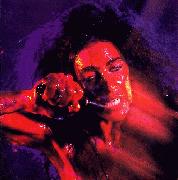
Review Summary: An examination of an avantgarde classic.
1982's
The Litanies of Satan is Diamanda Galas' first record, one of two she released before the death of her brother, Philip-Dimitri Galas, from AIDS, in 1986. Philip's death focused her career for several subsequent years in the form of a triple album outcry against the demonization of AIDS victims in popular media, dubbed her Masque of the Red Death trilogy (
The Divine Punishment,
Saint of the Pit, and
You Must Be Certain of the Devil). [1] The indifferent stance of the Catholic Church on the AIDS crisis infuriated Galas, and she performed her 1991 live record,
Plague Mass - which features a selection of songs from the trilogy records - in New York City's Cathedral of St. John the Divine half-naked and covered in blood. While
The Litanies of Satan does not discuss the AIDS virus, it
does display Diamanda's antipathy for religion, demonstrating that the ecclesiastical disdain which informed her later work was present even before the indifferent Catholic response to the AIDS crisis. That indifference intensified her distaste rather than originated it.
In "Pop Music, Pop Culture," Chris Rojek describes the record as "experimental pop." That is an utterly inaccurate portrayal. (He also misspells Diamanda's first name as "Diamada.") [2] There is nothing on
The Litanies of Satan to imply it has even the remotest connection to pop music. Its two compositions are lengthy - seventeen and twelve minutes, respectively - traditional song structure and instrumentation are eschewed, and the lyrics - when there
are lyrics - are recitations from French poet Charles Baudelaire's "Les Litanies de Satan," as per the first track, and the incoherent ramblings of a psychopath, as per the second [3]. Neither correspond to the aesthetics of pop.
The title song is a recitation of the aforementioned Baudelaire poem and the poem, simply, is a renunciation of Catholicism. One of its most egregious sentiments, as seen at the time of its publication in 1857, was equating humankind with Satan, in that both experienced divine injustice [4]. Galas' song mirrors this relationship, interspersing Satantic ranting and vocal effect work with excerpts from the poem spoken in their original French. She opens the piece with terrifying layered screeches and howls before launching into an impassioned a capella recitation, backed by only occasional percussion hits (a technique she would later use for
Plague Mass's "This Is the Law of the Plague"). The piece, for its remainder, masterfully utilizes effect work to amplify the frightening, underworldly atmosphere Galas' vocals, which frequently take glossolalia form, create. It's a dramatic opening.
"Wild Women with Steak Knives," subtitled "The Homicidal Love Song for Solo Scream," is an a capella piece, purportedly recorded in a freezing cold London basement after Diamanda had been awake, sick, for over 24 hours. The track represents the innerworkings of a psychotic individual, expressing them through Galas' multitudinous vocal techniques: screaming, spitting, howling, wailing. As such, it is a difficult listen for even those accustomed with the depths of the avantgarde. This difficulty is intentional, though; the purpose of the piece is to transform the listener into an observer of psychosis, and its extremity creates a contrast between it and the listener, strengthening the distinction between the two and rendering its message stronger. Indeed, since a fundamental stage of psychosis is the inability to share "experiences on the basis of a shared, stipulated order" [5], "Wild Women," with its chaotic, disturbing vocalizations, embodies this most effectively. Conceptually, then, it succeeds, but indeed musically it does too: there is a fury and maniacal energy to the track which is made all the more remarkable by the fact that Galas recorded these sounds live and using only her voice.
Galas exclaims midway through the piece, in a lyrical moment: "I am not talking about meatballs, I am talking about steak!" While this is often dismissed as a manifestation of the psychosis the song is representing, I argue that it represents a moment of lucidity in the song's psychotic character, and also then, why the song title includes steak knives. The meatball blends several varieties of disparate animal carcass together; the steak is a single cut. For the psychotic patient, this is an attempt to confer the purity of her expression-- perhaps the psychosis she, the 'wild woman,' is experiencing is merely unfiltered expression; or, an expression unsullied by the cultural constructs of language and behaviour. Thereby, the woman is not
really wild. The steak knife is used by those who are not wild to interact with the steak, and thus, to fully close the comparison, Diamanda herself is the wild woman, and the steak knife is the song itself, bridging the gap between humanity and the psychotic in allowing the two interaction.
The Litanies of Satan is a remarkable record, for both its unconventionality and vocal virtuosity. While a challenging listen, the adventurous listener will find a rewarding journey in descending to its dark, perilous depths. Ultimately, it is fierce, passionate, and engages themes of religion and psychosis in a fascinating manner.
- - - - - - -
[1] http://culturefusionreviews.com/2013/04/18/litanies-of-satan-by-diamanda-galas/
[2] https://books.google.ca/books?id=u_FYpzAljCUC&pg=PA84&redir_esc=y# v=onepage&q&f=false
[3] http://diamandagalas.com/writings/a-homicidal-love-song-for-the-solo-scream-on-the-music-of-psychotic-states-of-mind-by-lech-kalita/
[4] https://books.google.co.uk/books?id=j89cAAAAMAAJ&q=%22Les+Litanies+de+Sat an%22&dq=%22Les+Litanies+de+Satan%22&lr=&a mp;pgis=1&hl=en
[5] http://diamandagalas.com/writings/a-homicidal-love-song-for-the-solo-scream-on-the-music-of-psychotic-states-of-mind-by-lech-kalita/