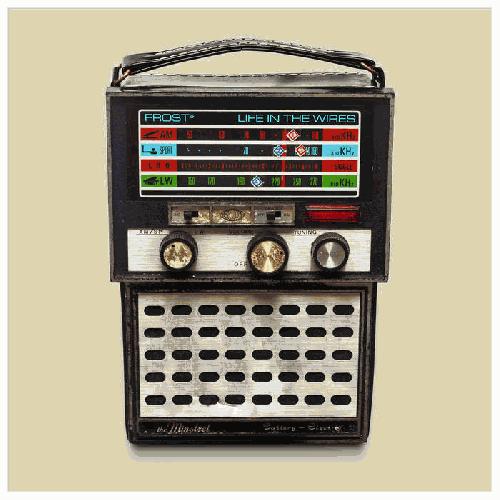
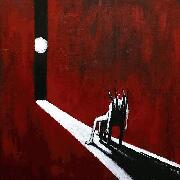
Review Summary: Frost* bring back the solos for a double LP concept album that oxymoronically slows down too fast, and well overstays its welcome.
I haven't kept the biggest eye on the contemporary prog rock scene, as it felt like an oxymoron for many years, with so many acts just recycling the same sonic cliches ad nauseum. Hard for a genre to feel “progressive” when it's so resistant to new synth tones past the same mellotrons and Hammonds from the glory days of the 70s. We may be finally entering a paradigm shift, however; Haken's last album saw some wild pop experiments, Devin Townsend is leaning into his downtempo side, even weirdo fifth wave emo band Glass Beach decided to get in on the fun this year. But that doesn't mean the oldheads are done with their tired tricks, as the “long awaited” return of Mike Portnoy to Dream Theater and actually anticipated return of Porcupine Tree prove. Flower Kings, Kaipa, Marillion, King's X, Vai and Gilbert, Transatlantic, all names that have been kicking around for way too long with the same one suite of sounds. Did you even know Yes made another album last year?
Of course, the band I was hoping would buck this trend is Frost*, creators behind Falling Satellites, which remains my favorite album ever made a good eight years after its release. From the beginning of their career up to now, Frost* have been consistent in upping the game in prog's capacity for creativity, taking the same synth organ sounds and shredding solos but infusing them with more life, atmosphere and especially electronic flourishes. The best Frost* records have a cinematic quality to them, a story pulsing through the veins of every note played. One would think, then, that the optimal creative evolution would be to highlight said story and said veins, and so Frost* have given us Life In The Wires...a double LP concept album about a near-future dystopia where AI has taken over the world. The world was aching for one of those, lord knows Ayreon hasn't dropped one in the past five minutes!
No sense in tip-toeing around my opinion; Life In The Wires is in a dead heat with Experiments In Mass Appeal for Frost*'s worst album, and while their biggest sources of inspiration are wildly different (LITW is classic prog, EIMA mined from Foo Fighters), the end result feels nigh the same in creative exhaustion and aesthetic underdevelopment. The marketing would have you believe this is a return to the band's roots, all Milliontowns and endless solos and bombast, but putting aside the dubious quality of even these moments, the album's pacing is mostly an endless string of ballads and sweeping symphonies, where the big instrumental moments are more jam band than prog virtuosity. These are all problems that plagued previous album Day And Age, but Life In The Wires lacks the gripping political edge of that album even with a genuine attempt to follow its tone. Oh and it's ninety minutes. You can't really be doing that in an era where Black MIDI were making the most original music ever made at just fourty minutes apiece.
Not for nothing does this album earn my apathy, but it gets off to a great start. Kicking off with the “can you hear me?” sample that ended Day & Age, Skywaving and Life In The Wires Pt. 1 make for an excellent slice of neo-prog goodness. It's a more condensed version of their sweeping symphonic bigness than I'd have liked, but it does have all the trademarks that you'd want to hear: gritty synth solos, big choir vocals, catchy hooks. Most importantly, the pacing is modular and dynamic. All the building blocks are pretty basic, but they're arranged in a way that the song is never boring. Follow-up This House Of Winter takes this ethos and applies it in the opposite direction, mirroring the slow and dour piano-driven balladry of Waiting For The Lie but slowly amping it up, ultimately featuring one of my favorite John Mitchell solos. Combined with the 7/8 meter, it's a song that's both intriguing and entertaining.
After that, it just falls apart. The string of songs from Solid State Orchestra through to School/Propergander is awash with airy ballads with only intermittent stints of bombastic instrumentation, and without a lot of titanic riffs or flashes of virtuosity. See, the weird thing about LITW is that while it does omit the (silly, in hindsight) decision to deprive Day And Age of any solos, it's not exactly bursting with “real” solos itself. Instruments blast out noise all at once, but none of them take the spotlight to rise above the synth fuzz and demonstrate individuality or melodic alacrity. The main riff to Idiot Box is fast and furious but still doesn't feel exciting enough to stand out. Evaporator features some dual guitar work that feels evocative of Ghost's best moments, but it feels too little too late in a song that lasts eight minutes and feels twice as long.
Parts of that song where the chorus kicks in, one would expect the pace to pick up, the drums to quicken, the bass to pop and slam. Instead, the rhythmic backdrop hollows out, giving no pay-off to an otherwise strong hook. This album's pacing is just poor, smoothed out where it should be a rolling hill. Much of the band's elasticity feels lost in the process, really. The last album was mostly sung by back-up vocalist and guitarist John Mitchell, so instead it's all Jem Godfrey this time. Much like the promise of endless solos, it feels like an overcorrection to what was a genuine flaw in DAA, because without a call-and-response like Heartstrings or Black Light Machine, it feels like the character of Frost* is missing something.
Perhaps the string of slower songs would feel more earned if the concept and lyrics were more interesting, but Life In The Wires has one of the more lop-sided storytelling conceits I've seen in this genre. Definitely not the most original idea, though! Naio is a bored kid from the suburbs, being sucked into the drone of cyberspace controlled by the All-Seeing Eye, when he finds an old radio and starts listening to Livewire, some kind of old wistful DJ. In an effort to escape the drudgery of modern life, Naio travels east in an effort to find him, earning the ire of the Eye and its followers along the way. A parable about how much AI is ruining creativity does play better in 2024, when the internet does in fact suck now, than it did when Dream Theater tried it in 2016, but not by that much; it's still a cornball concept. The narration from Livewire himself at the end of each song from Evaporator to Sign Of Life gets repetitive, and as it stops, it feels like a half-baked remnant of a more verbose story and universe. Nothing in LITW's melancholic nostalgia for analog hardware and finger-wagging at people staring at their phones too much (please stop doing this, mister Lonely Robot) hits nearly as hard as the multiple suicides or Karen samples at the end of Day And Age.
Things pick up when we hit School and Propergander, a double whammy of gritty hard rock. The texture and tones are doing a lot of the heavy lifting, but they're still a great shot of adrenaline with some of the slickest turns of phrase on the album, sonically and lyrically. Sign Of Life follows this and brings the album back to ballad territory, but it works as a palette cleanser, sandwiched between the previous songs and the combined twenty four minute prog rock juggernaut of Moral And Consequence and Life In The Wires Pt. 2, both jammerific jammy jams that do live up to the promise of endless solos after Day And Age's drought. And I gotta admit, even after talking smack about how little prog rock has evolved, I do enjoy hearing that gritty Deep Purple-esque Hammond organ. LITW Pt. 2 may be a retro kind of fun but it's still a lot of fun. The band even invited some old members to help with the jam, something that hasn't happened since The Dividing Line.
The album as a whole is littered with callbacks to the band's catalogue, with direct references to Falling Satellites (SSO), The Dividing Line (Moral And Consequence), Milliontown's title track (LITW2), even Milliontown's iconic synth tone is reused in School. With the band reunion, it feels like it should be a victory lap for the band, a greatest hits after nearly two decades as prog rock's dark horse darling. But even if it did live up to that promise, is that what we want from Frost*? I might be sitting at a lonely table for one when I say that this album needed a moment like Towerblock or Lights Out to break things up, but without them, the basic building blocks of their symphonic neo-prog sound just aren't strong enough to carry the album, not with the relative dearth of hard-hitting moments. Even catchy hooks like Strange World fall flat when the sound is so static.
It does have moments, but Life In The Wires' problems are too fundamental to ignore, and too egregious not to seriously consider it the band's weakest outing. The electronic motifs don't have the forward-thinking charge of Falling Satellites or Milliontown, the solos were overpromised and the performances underdeliver, the ratio of ballads to bangers is well off...and the album really is just way too long. I can't just say it would be better if the album were cut in half; a concept like this does need slower songs, but also basically every song is too long anyway. The false stop in Moral annoys me every single time, and even This House In Winter needed to lose a minute and a half. Don't mistake this review for hate, because I still love this “sound”. But these “compositions” miss the mark hard, and make me miss when Glass Beach were getting their feet wet in prog in 2024. Considering that album has Guitar Song, the most boring song in the universe, that is saying something!