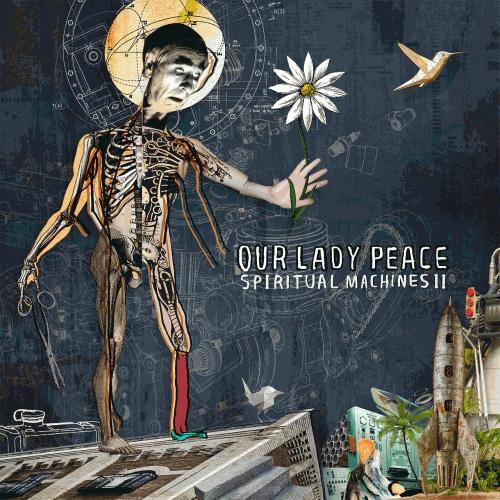
Review Summary: Are we still spiritual machines?
When, after many years, a band decides to release a sequel to a financially successful and/or critically acclaimed album, it often gives off a sense of sheer desperation. Most likely, by this time their popularity is limited to a small but devoted fanbase, and their discography is full of misses and failures. In a desperate attempt to release a “relevant” album, they finally decide to work on a sequel.
All of the above is pretty much spot-on regarding Canada’s own Our Lady Peace. After releasing four solid LPs, the band – led by the one and only Raine Maida – pivoted toward indistinct pop-rock territory, where they have remained for the last 22 years. And even though the first four albums –
Naveed,
Clumsy,
Happiness… Is Not a Fish That You Can Catch, and
Spiritual Machines – might not fall strictly into the “classic” category, they certainly have their share of strengths.
Probably the biggest mystery here is how the band managed to lose their signature sound so easily. Is Raine the one to blame as he shifted to more “traditional” vocals, leaving his trademark eccentricities behind? Or was it the departure of guitarist Mike Turner, who may have had a much larger influence on Our Lady Peace’s sonic identity than previously thought? We will probably never know for sure. But I digress.
At first glance, the second part of
Spiritual Machines features many of the same ingredients. Once again, there are short spoken-word interludes from Ray Kurzweil (this time discussing new developments for the humankind) interspersed among the songs, with the band attempting to expand on these concepts within the tracks (yet once again without any real connective tissue between them).
However, the passage of time has left its stamp on their sound. There is not much left of the alternative and art rock that defined the band’s output back in 2000. Instead, they continue to operate strictly within the realm of modern pop-rock and its transient trends. Melodies have often been replaced by danceable, repetitive rhythms – something clearly demonstrated by the album’s first single,
Stop Making Stupid People Famous.
And yet, this shift in sound isn’t really the main issue here. Yes, the heavy rock days of Our Lady Peace are long behind them. But the primary failure of
Spiritual Machines II lies in the quality of the material itself, even if I would argue it’s somewhat stronger than their output from the preceding several releases. It is difficult to say whether these repetitive rhythms are entirely to blame, but the songs on the new album simply leave no lasting impression. At times, they feel less like finished products and more like mere demos – rough sketches of tracks waiting to take final form.
No cut here reaches the heights of
Right Behind You,
In Repair,
Are You Sad, or other standouts from Part One. While it is certainly praiseworthy that the band didn’t simply try to carbon-copy the sound of a 20-year-old record, the shriveled musical ambitions of Part Two leave much to be desired.
As a result,
Spiritual Machines II became a textbook case of a belated sequel plagued by typical issues. Nothing here holds a candle to its predecessor, though there are a few decent cuts (such as the somber
Holes or the funky
Run). Inevitable comparisons to the time-tested original do the newcomer no favors, though it’s difficult to call it a complete failure either (truth be told, expectations were already quite low). Still, after a few spins, there isn’t much desire to return to
Spiritual Machines II. So, while we can give Our Lady Peace credit for the attempt, it falls far short of an outright success.