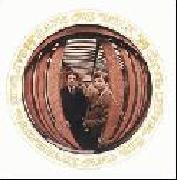
Review Summary: Cold's junior release is far removed from the band's grungier roots displayed on their self-titled album and especially on '13 Ways to Bleed On Stage,' instead opting for a more cleanly-produced album aimed for mainstream success.
Year of the Spider was a highly-anticipated third release from Floridian post-grungers-turned-hard-rockers Cold. Released nearly three years after the critically-acclaimed
13 Ways to Bleed On Stage, questions swirled about the album: would it still hold the same haunting, darker vibe of its predecessors, or would the album take a different turn? How much has frontman Scooter Ward's vocals improved compared to the first two albums? Would bassist Jeremy Marshall and drummer Sam McCandless continue to act as a solid rhythm section? Lastly, how would Kelly Hayes and Terry Balsamo function as the guitarist core for their second album together, after a well-executed display on the band's sophomore release? In 2003, the hard rock community was expecting a similar vibe from Cold: dark, haunting vocals with the trademark effect-laden guitars and solid percussion; however,
Year of the Spider diverges from this temperament to that of a more mainstream album with much cleaner production. However, the cleaner production is not necessarily a drawback; rather, it was simply something unexpected from Cold. As a result,
Year of the Spider appeared to be marketed to the mainstream, much to the chagrin of the cult-like following that developed, especially after
13 Ways to Bleed On Stage's release.
The positives outweigh the negatives on this album quite clearly, although the disparity isn't as great as it is on
13 Ways to Bleed On Stage. For instance, Scooter's voice has strengthened by leaps-and-bounds on the album, and his ability to hit his upper register effortlessly is a pleasantly welcome addition. Further, the rhythm section of Marshall and McCandless continues to excel at giving Cold's music life with their pulsating bass and percussion, and the guitarist duo of Hayes and Balsamo do a tremendous job of switching between rhythm and lead throughout the album, effectively feeding off each other's beefy power chord-driven rhythm riffs with intricate lead harmonies.
The beautiful Sierra Swan, unofficially known as "the sixth member of Cold," again makes her appearance on two tracks:
Suffocate and
Kill the Music Industry. The latter track is the heaviest track on the album, sporting nothing but an exorbitant amount of distortion and power chords, coupled with Scooter's and Sierra's shrieking, dubbed vocals being one of the album's most bizarre points. And it doesn't take a rocket scientist to figure out what the track is about, either, with Scooter's palpable distaste for record executives telling bands to do [this] and not [that]. The former track,
Suffocate, features the Scooter/Sierra tandem at their best. Throughout, they portray a man and woman or a boy and girl in a relationship, each accusing the other of ruining the relationship they share. For instance, Scooter's character claims that Sierra's character lies, is fake, and "always takes what [she] can," which is constantly refuted by Sierra's character. In support of this to-and-fro story lies some elegant lead lines from Balsamo, who, along with Hayes, has an explosive chorus riff that lines up brilliantly with the rhythm section of Marshall and McCandless.
On
Year of the Spider, Cold's biggest strengths lie in the slower numbers. For example,
Wasted Years is a predominantly acoustic track that also features an orchestral accompaniment. Scooter describes the track as being about seeing how all his friends are in their thirties and still at the bar every night, but in the end, "[T]here's all this time that's gone but you wish you could get back." The orchestra and acoustic guitar begin the song, which gradually builds and climaxes with the other instruments and electric guitar. The most memorable passage is the chorus that follows the acoustic and electric guitar solo, with Scooter asking, "Was it life I've betrayed for the shape that I'm in? It's not hard to fail, it's not easy to win." The orchestra's influence on the track is immense, adding an incredible dimension to the already-somber song. The piano also plays a huge role in a couple tracks, especially
The Day Seattle Died, which is Cold's tribute to the late Layne Staley and Kurt Cobain, as evidenced by allusions to the two men throughout the lyrics; for instance, Scooter says that "You sat in your angry chair and just tried to be you," in reference to Staley, and in the chorus, Scooter touches Cobain's legacy in music, singing "Blown away by fame, we couldn't hear the shotgun hit the floor - nevermind in faith if you can't believe." The rollicking, triplet-riddled piano solo in the bridge builds to a feverish intensity and the song soars from its conclusion.
While
Wasted Years is probably the most beautifully arranged and written acoustic track on the album, the elegance of
Cure My Tragedy (A Letter to God) is not far behind. Written about Scooter's sister who was diagnosed with cancer, the track highlights Scooter at his most fragile. Throughout the track, Scooter sings as if he's right by his sister's bedside, telling stories of their childhood growing up and how they stuck up for each other. The bond that he and his sister share is seemingly unbreakable - "Every time you cried, it would take my wind; my heart would break," sings Scooter softly. Scooter's vocals and screams could potentially carry the track on its own, but Balsamo's shrill, wailing guitar solo that accompanies Scooter's screams has the potential to send chills up and down one's spine. The delay effect used by Balsamo in the introduction is also wonderfully done, but the outro - again with the wailing guitar solo - is the apex of the track, with Scooter begging to God, "Won't you take and give her pain to me, 'cause my whole life I've made mistakes," essentially saying that he, not his sister, should be the one that should be in pain for all the mistakes he's made in life.
Throughout Cold's discography, Scooter has never been a purposefully vague lyrics writer - if there was a single track out of Cold's entire discography that highlights him at his strongest and weakest moments as a human being and a brother instead of a musician,
Cure My Tragedy (A Letter to God) would be an absolute frontrunner, as well as
Gone Away, which is the hidden track on the album, ironically beginning 13:13 after the last track. Balsamo and Hayes beautifully illuminate the track with their use of delay and echo, but their simple-yet-highly-effective solos are an absolute must-listen, especially in the track's closing chorus. McCandless and Marshall also play a significant role in the track behind the delayed effect used on the guitars, and also in
Don't Belong's introduction, giving the rhythm section vibrant life.
The most troubling aspect of the album is the enigma
Stupid Girl, which is a song that fans of the band never expected to hear Cold write and perform. To explain, Scooter states, "I wrote the riff to this song... and it always sounded to me like a Weezer song - so much that when I was recording the verses, I couldn't sing on it. Naturally, I called Rivers Cuomo, who's a good buddy of ours, and asked him to write some lyrics. He sent 'em back, and it was awesome, so he sang on the verses and I did the chorus. The thing is, he never explained to me what he thought the song was about, so I figured it was just about some stupid girl." But it's not only the lyrics that makes the song so blantantly contrasting from the rest of Cold's work - it's the instruments as well. To put the 3:00 track into a one-sentence nutshell, it's simply a pop-rock, radio-friendly hit that is vocally, lyrically, and instrumentally uncharacteristic of the band's previous work. The song itself is not terrible, but it clearly falls victim to the mainstream demons with its overly-clean production and lovey-dovey song content: composed of nearly all triplets in 6/8 time, the song is brisk in pace, but maintains a sing-along quality, especially with the "Whoa-oh-oh-oh" vocal melodies in the bridge. The lead guitar part of the song is lively and festive, but the band, especially Scooter, would later attempt to disown the track, frustrated at the overexposure that it received and the media's incessant declarations of Cold becoming pop rockers who desired to move away from their post-grunge roots.
There are other tracks that are extremely poor. For instance,
Sad/Happy is what Scooter describes as an "Aerosmith/Jamie's Got a Gun thing, taken from things that fans have actually told us." In it, an abused daughter fights back, except to poor, overly-distorted guitars that excessively use the effects. Normally, Balsamo and Hayes know when not to go overboard with guitar effects, but they make a mis-step on this particular track, and the rest of the song suffers for it. Also,
Kill the Music Industry is an inexcusable closer with its out-of-nowhere anger, excessively-distorted guitars, and ridiculously-dubbed vocals, ending the album on a sour note until the hidden track.
Ultimately, the album is a quite solid hard rock album that was obviously manufactured for mainstream success, even though only one of the two singles released,
Stupid Girl, enjoyed considerable fame, which was not even the band's choice for a single due to it being so incredibly antithetic to the band's staple sound. Scooter Ward's signature straightforward lyrics that come from his heart and experiences in life, as well as the brilliant-at-times guitarwork displayed by the tandem of Terry Balsamo and Kelly Hayes, and the always-steady rhythm section of Sam McCandless and Jeremy Marshall comprise an otherwise solid line-up on the album, and the vocals and instrumentation are great for the most part. Further, Scooter's vocals have improved since their last album. There are some killer cuts on this album, especially
Wasted Years,
Cure My Tragedy (A Letter to God), and
Gone Away, which are essential listening and classic Cold tracks. The album's squeaky-clean production helps bring out the best in the poppier tracks on the album - especially
Stupid Girl - which is a plus for fans looking for less elegiac Cold material, but frustrating to fans of Cold's previous work. Overall, the album is a good hard rock album that combines straight-forward, power chord-driven hard rock (like in
Remedy) along with slower acoustic tracks (a la
Black Sunday), but there are some awfully bland and uninteresting tracks on the album, and
Year of the Spider's clean production can be a significant distraction, particularly to fans of the band's earlier discs.
B+
Jom recommends:
Wasted Years
Gone Away
Cure My Tragedy (A Letter to God)
The Day Seattle Died