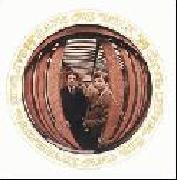
Review Summary: Television's debut Marquee Moon introduced the world to post-punk, as role model/Tom Verlaine became one of the inspirations to current day bands The Strokes, The Libertines, and Dirty Pretty Things. One of the best simple rock records of all time
Julian Casablancas simply wants to be in Tom Verlaine's pants. No way around it. Verlaine is the role model for the genre of hip-indie, the definition of the urban metrosexual. His complexion is near ghostly, with his pale face seemingly being sucked into his eye sockets, causing a shadow to be cast over his hazel eyes. His expression is that of a mischievous troubadour, a man who always seems to have something more deviant on his mind than the conversation he's carrying on with you. Somehow always carrying a cigarette in his hand, Verlaine's style and joie de vivre contributed to the current renaissance of the skinny tie and tight khakis that is thriving right now in American Urbana. But it was not Verlaine's looks that made him one of the endearing and influential men in rock and roll history. It was his music. When he and his band Television debuted with
Marquee Moon in the mid 1970's, the world had never heard anything like it before. Verlaine's writing style was twisted, dark in some ways, but his words were hidden between jangly dual guitars and upbeat Stones-On-Acid tunes. Lyrics like "I understand all destructive urges. They seem so perfect. I see no evil" portray a seemingly unstable mind, whereas the irony lays in that they're sung in a charmingly discarded sense over a bending guitar riff that shows no sign of inner torment. This combat, joy verses twisted sense of humor could not be put into the same category as modern rock and roll, and it was nowhere near the flamboyant effect-laden prog rock bands that dominated the radio. Unbeknownst to Verlaine and Television, they invented their own style of rock and roll. And they carried it with a swagger and ***-it-all mentality the world hadn't yet come to embrace. Television's impact is unquestionable. The album is
Marquee Moon.
Now, Television isn't necessarily a technically proficient rock band, or has any amazing skill in some way that sets them up right next to Led Zeppelin. Television is to rock and roll as what The Ramones were to punk. While the Ramones proved you didn't have to be bloody amazing at your instrument to be a classic band, Television was an example of how you stop excessing and play a minimalist form of rock and roll and not sound like you were from the fifties. Their songs are simple sure enough, but making simple rock timeless is difficult. The initial love of these four-boys-with-instruments band, whose tunes are catchy as hell, surely would die out eventually. Look what happened to the Arctic Monkeys. But by the time the ten minutes of the epically sweeping and soloing title track- which is based of one chord flipping between major and minor hits- is finished, it's understood just how good Television really is. The talent is in the song construction. Verlaine is a master of melody, and though his voice isn't near the greatest the world has ever seen- most hacks of the current generation could belt out a Verlaine song whenever they wanted- Verlaine could draw into a tune. His lyrics were vague, but with vagueness opens up interpretation, and the intrigue stems from this point. He knew how to make rock and roll fun, while at the same time exposing it for what it was. On
Friction, he laments "You know all us boys gonna wind up in jail. I don't wanna grow up there's too much contradiction," muckraking the falsehoods in the ideals that when you are a rock star, you are young forever. Of course, Verlaine possibly had not even the slightest clue what he was writing when he said this, making it more interesting. Hence, his vagueness becomes a point of Television's charm.
With all of Verlaine's lyrical hits and misses, it's easy to miss his dual guitar work with partner Richard Lloyd. Verlaine is quoted as saying that his guitar work is like two hands on the piano, the lead playing the right hand, and the rhythm playing the left. On
Marquee Moon, it's not difficult to envision the guitar licks being played on a piano, and on tracks such as
Venus, the guitar itself sounds like a keyboard imitating a fender. This is exactly what Television strived for, by using tight toned Fenders instead of bombastic Les Pauls with distortion pedals and all the jazz. Lloyd uses this point to soar lead riffs all over songs, verse, chorus, bridge all included. On mid-album twisted ballad
Elevation, Lloyd solos cleanly (and quite excellently) whereas other bands would have used echo effects.
Elevation is a chance for the entire band to flex their muscle, as Fred Smith's sighing bass lines power the driving high-hat runs by Billy Ficca. The syncopated chorus is difficult, even though it's a weak point in the song, but it shows what Television could do if they worked at it. Maybe they could be like Zeppelin or Yes if they felt like it, but the beauty of it is that they don't. They're rooted in their sound, and they've found gold. Songs such as
Prove It are gorgeously locked in their feel, which in this case is a classic rock ballad done Television, like a turned up "Blue Moon". Verlaine's sighing "Now the rose it slows you in such colorless clothes. Fantastic! You lose your sense of human" is a deliciously malicious, snarling snippet of a line, lost in his perfected yelp. It's typical of
Marquee Moon's blend between maturity and adolescence, and Verlaine uses his original rock and roll influences to make another slick track on the album.
Much of
Marquee Moon characterizes the rhythm heavy sound of future post-punk bands, and because that is the case, Ficca and Smith constantly bring the best. Smith's bass lines are fun and funky, a blend between expert pluckers Paul McCartney and Thin Lizzy. His work is shines throughout
Marquee Moon's 8 song duration (which isn't that short, since 5/8ths of the album's songs stretch over 5 minutes, with
Friction coming up 15 seconds short of making the cut), and his clean finger picking tone is a breath of fresh air from the uniform picking of bands that would cite him as an influence. His play with Billy Ficca is endearing, such as on the light ballad
Guiding Light. Throughout
Marquee Moon, Ficca plays behind the kit grandly but also with a reserved sense of knowing not to overdo it. His roll opening the marching piano finale
Torn Curtain is excellently handled, as the pitch of his drum changes pitches with Ficca's usage of a tightening pedal.
Torn Curtain is a far cry for Television from the poppy licks of
Venus. Lloyd uses his guitar to whine under Verlaine's beautiful shouts of "Tears holding back the years. The tears I never shed. The years I've seen before." Lloyd solos in both major and minor over Ficca's crash heavy beat and circling rolls, making none of
Torn Curtain's 7 minutes drag. It's the boldest look into the inner workings of Tom Verlaine, a place he himself may not know exists. The song turns on both sides of powerful and beautiful, making one beast of a song. At this point of
Marquee Moon, the listener understands the hype and Television's point. They're there to be whatever you wish them to, and they seem to be adequate at playing each one.
And thus ends the story of Television. As quickly as they emerged and churned out a near-perfect album for the ages, as quickly they disappeared. They released another album,
Adventure, but it was neither as popular nor as good as
Marquee Moon. Perhaps it is better this way. Alone,
Marquee Moon stands as a definitive album, a piece that rocks the listener hard, soft, and smooth, sometimes all in a span of twenty seconds. And while their career rose and fell quickly, their influence remains heavy. Tom Verlaine is the original party boy, and traces of Television's sound lay all around bands of the current era. Many music critics cite Television as the first post-punk band, and they may be right, with Television's rhythm heavy style and tightly wrapped song construction being used later by bands far less happy. But it all comes down in the end to Tom Verlaine. His style, songs, and lyrics are what define Television and
Marquee Moon. He is a man that is the life of the party, but snippets of
Marquee Moon show his darker side. He's another rock star, and perhaps he knows it. That line of
Friction, "I don't want to grow up, there's too much contradiction," seems to say Verlaine knew he wanted to get up then get out before he got old. As Neil Young once said, it's better to flame out then fizzle out. Television's flame still burns.
Recommended Tracks
See No Evil
Friction
Marquee Moon
Torn Curtain