Review Summary: Old habits die hard, but they somewhat payoff.
Rhapsody (of Fire) was never a popular band to begin with. With so many other artists that were changing the genre of metal as we know it within the early nineties, audiences were much more interested in what was new rather than sticking with the same old formulaic music over and over again. Their third album,
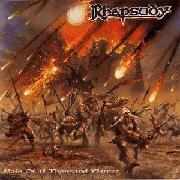
Dawn of Victory is no exception. If anything, this was probably the worst timing in history to release an album that was in similar style to earlier power metal artists. The whole music industry was changing, with System of a Down’s
Toxicity becoming a huge critical and commercial hit and Linkin Park’s
Hybrid Theory making a huge boom in the nu-metal genre that wasn’t seen for the last ten-to-fifteen years, no one wanted to stick to the “olden days” of metal per say.
To give Rhapsody credit, they do in fact change a couple of things in this album that they never really did in their last two albums,
Legendary Tales and
Tales of Enchanted Lands. First off, it’s a tighter, if not more restricted sound than it was before. The overall instrumentation, while still well executed, plays less of a roll giving the vocals and orchestrations a push to the front seat to carry the heavy weight of keeping the audience’s attention. However, it’s not a bad thing for Rhapsody to do this because the energy is still present. This time it’s Fabio that has to carry it throughout most of the record instead of Truilli and the other members, and he does so quite nicely. He still places his voice in a flowing manner, and the choir vocals back him up nicely such as in the title track. This showcases that Rhapsody is starting to break from their comfort zone since the last two albums had a much more guitar oriented sound. Not much can be said about the lyrics other than it still has its “cheesy charm” if you will, continuing the story from before.
However, the one thing that Rhapsody doesn’t change is the formulaic structure. It still starts off with the typical instrumental whose purpose is to build the suspense into the next track (though the way the sound is in the album, some may find the album a little lackluster) which pounds into the complexity of its flashy guitars and drums, which again are well-performed. Then there’s the instrumental interlude which surprisingly arrives rather late into the album, making a rather pointless attempt to dissolve monotony as it’s the only slower, ballad sounding song in the album. However, it doesn’t negatively affect the album greatly due to the bands rather well made decision to change a few things to keep the record from going stale.
Even if
Dawn of Victory doesn’t truly break any barriers for Rhapsody, it still remains an enjoyable record for the most part. Some may find that the similarities and comparisons to their last two records would have
Dawn of Victory make Rhapsody a repetitive and stale group, and I don’t blame them. But this record can be summed up like this: Rhapsody changes a few necessary things, but they still hold with the same ideas from before. In other words, it’s nothing more than another Rhapsody album, but with a couple of alterations. And it works within its own right. It may as well be the least favorable of the first three albums, but it doesn’t make it bad in any way.