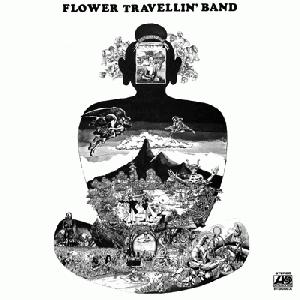
Review Summary: Heavy, adventurous, and ominously hypnotic. Satori's acid-induced rock sound is one that will leave the listener mesmerized until the final, mind-blowing note.
Flower Travellin' Band's 1971 masterpiece,
Satori, reflects a transitional, yet momentous, period in the history of rock music. The psychedelic movement of the previous decade was slowly dwindling in popularity, yet it's influence still held a degree of relevancy that managed to inspire the modern music scene. The fuzztoned, guitar sound and bombastic drum rhythms that were initially envisaged by groups like The Jimi Hendrix Experience, Cream, and Blue Cheer, were now being viewed as fundamental elements that gave root to the heavier styles of Black Sabbath, Deep Purple, and Led Zeppelin. Though at the same time, as proto-metal and hard rock were establishing their dominance in the mainstream, bands like King Crimson and Yes were developing a whole new elaborate brand of rock. The distorted heaviness was indeed a present aspect in their music, but these bands often looked to the abstract nature of psychedelia for inspiration. The adoption of elongated song structures and fantastical atmospheres became even more evident in the rock scene of time, and actually lent considerable leverage to the rise of progressive rock.
The unique sound of
Satori vividly captures the eclecticism of the '70s rock scene, and all of the different philosophies that were steadily evolving into fully recognized genres. Flower Travellin' Band have taken all of the various trends that were prospering at the time, and unionized them into a collective mélange of power and atmosphere. Here we'll find traces of early heavy metal and progressive rock, as well as nostalgic spectacles of florid psychedelia. Since the release of 1970's
Kirikyogen, Flower Travellin' Band have also been cultivating a heavily dissonant guitar style that emphasized on a low-tuned sound and slower tempos, thus giving their music a more menacing characteristic. Much like Black Sabbath's
Master Of Reality, Jacula's
In Cauda Semper Stat Venenum, and the heavy, prog-influenced sound of Lucifer's Friend have been credited with developing the idiosyncrasies of doom metal,
Kirikyogen also played a significant part in its creation as well. In fact,
Satori is yet another endeavor in honing the formidable and ominous sound that would become the essence of doom metal. Indeed,
Satori is a proto-doom, yet highly versatile, epic divided into 5 movements, each one more mystical than the last. This album is like a window into a warped and capricious state of mind, as the music flows along under its own agenda, while altering in both mood and style whenever
it deems appropriate.
The first movement, "Satori, Pt. I", opens the album with an unforgettable overture. As Joe Yamanaka screams into the microphone to signify the start of the album, the music steadily intensifies behind him so as to build up the suspense. And as we're drawn to the edge of our seat, completely succumbed with anticipation, Flower Travellin' Band commence their monolithic onslaught with proto-metallic riffage. This particular movement emphasizes more on a formidable volume and low-tuned guitar work rather than clever artistry. A majority of the piece is centered around a memorable riff and high-tone wail, which follows a melodic arrangement that is suspiciously similar to two of Slayer's forthcoming hits, "Raining Blood" and "South Of Heaven". In the second and fifth movements of
Satori, we find Flower Travellin' Band deviating their focus from heavy metal, and embellishing the atmosphere with a touch of mysticism. This is where the psychedelic and progressive rock influences are at their most conspicuous. There's a stronger emphasis on long instrumental passages and spacey melodies here, which allows Flower Travellin' Band to drift into profound, meditative ambiences. This section is very reminiscent to the acid-induced jams in Iron Butterfly's "In-A-Gadda-Da-Vida" and The Doors' "When The Music's Over", as it is completely reliant on radiating a similar, hypnotic environment. It's actually quite astonishing how Flower Travellin' Band is able to formulate mellow, psychedelic jams that incite the same magnetizing awe that their heavier style emanates. It's a kind of versatility that many bands aspired to harness at the time, but very few managed to pull off with a similar degree of expertise.
The third and fourth movements regress back to a heavier demeanor, which borrows influence from blues rock and heavy metal respectively. The third movement especially, signifies a return to the doom-tinged sound of the first movement, only this time, with a relaxed tempo that continues to be influenced by the psychedelic vibes of "Satori, Pt. II". Nevertheless, the obsessively dark aura that consumes this piece, as well as the dynamic prowess that takes over in the midsection, manages to give it a consciously metallic feel. The fourth movement, on the other hand, pursues a bluesy rock sound. This was a rather popular trend at the time, as various rock bands were still showing a sincere interest in the 'blues explosion' of the mid '60s. Joe Yamanaka even has the audacity to bring out a harmonica to compliment Hideki Ishima's riffs and solo work, thus formulating "Satori, Pt. IV" into a 'Zeppelin-like' groove.
I was personally bewildered by the sheer ingenuity of
Satori. The mind-bending jams, the hypnotically vibrant riffs,
Satori just showcases a virtually unparalleled mastery of every genre it embraces. As previously mentioned, this album is like a musical collage of strangely mixed elements from proto-metal, progressive rock, and psychedelia, which mirrors the evolution that rock music was undergoing in the early '70s. Listening to this album is like experiencing an LSD-trip gone awry, with the listener trapped in a labyrinthine funhouse that appears more enigmatic over time. Though this hallucinatory theme is only for the sake atmosphere, as
Satori is much more than mere background music for drug-usage. This album, with its dynamic shifts in mood and eclectic range of styles, takes rock and psychedelic concepts to their absolute limits. Flower Travellin' Band illustrate such a sophisticated, yet primally forceful sound that if it would have been given more attention in the western hemisphere, it could have had the potential to cast a shadow over every other release of its time.