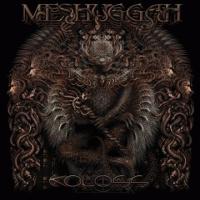
Review Summary: A lack of new ideas make this album feel like another step sideways, but a more concise and physical approach make Koloss Meshuggah's most accessible album.
Meshuggah's latest album,
Koloss, is another step sideways by a band with a history of pushing forwards. After a string of innovative albums, the band peaked in 2005 with
Catch Thirtythr33, a single song which displayed a near-classical mastery of large scale structure in addition to seeing the band at their most texturally and harmonically experimental. However, since they were unable to play the entire song live, they responded with 2008's
obZen, an album largely tailored towards live performance and gaining new fans at the expense of experimentation.
Koloss takes this same principle even further - every song on this album is live ready (even the instrumental outro apparently had its origins as an introductory piece for their live show), and the music will likely inspire mosh pits thanks to its immediacy and increased accessibility.
This approach is evident right from the start of
Koloss. The first song,
I Am Colossus, has the shortest intro of any Meshuggah opening track yet - a brief riff excerpt is immediately followed by Jens Kidman's ferocious bellow. This track has a monstrous groove which may take a few listens to wrap your head around, but there's not much here to surprise anyone who listened to the band's previous album,
obZen - the verses consist of a low F tritone chug at a slow tempo, straight out of the verses of
obZen's fourth song,
Lethargica (and on the same chord), while the chorus consists of an ascending chromatic riff, a Meshuggah trademark. This is followed by a fast bridge lifted straight out of
obZen's closing track,
Dancers to a Discordant System. The song's one surprise follows in the form of a terrifying sirenesque lead. The lyrics, written by the band's drummer, Tomas Haake, also cover familiar ground: corporate greed and government control, which serve as the themes for the entire album.
The next song,
The Demon's Name is Surveillance, is the only song on
Koloss penned solely by lead guitarist Fredrik Thordendal, and it shows - on first listen, it will sound to many like an extension of
Bleed. But don't be fooled by the simple pop structure and a solo which is taken straight off of the band's third album,
Chaosphere - between the six string guitars, a groove in 3, and some novel uses of a shifiting rhythmic motive, this song actually has the most new ideas of any song on
Koloss.
Do Not Look Down, on the other hand, returns to the 8-string guitars, and between its funk-inspired groove which approaches a nu-metal bounce and a joke solo, the song sounds like a self-parody. It will make you want to move in ways that you wouldn't expect a band like Meshuggah to inspire, for better or worse.
Behind the Sun will instantly hypnotize you with its heavily layered intro - so much so that you may neglect to notice that the first half of the song doesn't contain any polymeters (instead, it obscures its 4/4 time signature by placing all of the snare hits on off beats). The slow introductory section is soon replaced by tremolo-picked odd time guitars and the most aggressive vocal performance on the album, leading the song to feel a bit like Gojira or Strapping Young Lad at times. This is the only song on the album with music written by vocalist Jens Kidman, which is somewhat surprising, as it is the album's best track.
The Hurt that Finds You First is rhythm guitarist Mårten Hagström's response to Thordendal's thrash tribute,
Combustion (the opening track on obZen). While this song has the same hammering thrash drum beat as
Combustion, it is a more interesting song thanks to its odd time signatures and a reverse build-up ending which makes up for the song's highly repetitive first half.
Marrow is remarkable for its drum part - while many of the drum parts on the album sound near-programmed due to their minimalist approach, this song has a very active, fill-heavy drum part. This is the first time on a Meshuggah release since the
I EP (2004) that the drums have felt like they're being played by a real person. The second of the song's two guitar solos is quite interesting, and the middle of the song is filled with riffs that may remind older fans of
Corridor of Chameleons (the third song on
Chaosphere).
On the off chance that you hadn't gotten enough of Hagström's chugging tritones on a low F in
I Am Colossus and
obZen's
Lethargica and
Pravus, he provides another 6 minutes of them on the awkwardly-titled
Break Those Bones Whose Sinews Gave It Motion, in addition to more semitone and octatonic leads. These elements in combination with the 4/4-against-odd-time polymeter practically make this song one giant Meshuggah cliche, but it nonetheless manages to be appealing thanks to an incredibly violent groove. As the longest and most repetitive song on the album, it overstays its welcome.
For the mix, the band returned to Daniel Bergstrand, who mixed
Chaosphere in 1998 (every album in between was mixed by Meshuggah). The band describes
Koloss as being being more 'organic' than the band's previous work, but 'organic' is a relative term when it comes to a band with such mechanical music. Meshuggah hasn't used real tube amplifiers since the
I EP, and the guitar sounds on
Koloss were created through a combination of Fractal's AxeFX and Cubase VSTs. It is unclear whether or not the drum sound on this record contains any of the original recorded tones (none of the band's other recent output does - the drums on
obZen and
Re-Nothing were completely sample replaced, and
Catch Thirtythr33 was programmed), but they are a far cry from the very live-sounding drum tones of
Nothing. Nonetheless, the mix on
Koloss certainly has a lot more separation and punch than the mix on
obZen, which helps highlight the more visceral feel of this record.
While
Koloss would have benefitted from even more organic production and a little more innovation, it is still a deeply hypnotic and enjoyable listen. The album may not present much in the way of new ideas, but the increased emphasis on physicality make it the band's most accessible record. Meshuggah's previous recordings were highly intellectual, even in their most groove-oriented moments, but this album is focused on inspiring movement. To that end, it succeeds, which means the album will likely appeal much more to those who weren't previously interested in the band than to diehard fans.
The deluxe edition of this record includes a DVD which features a documentary on the recording of
Koloss. It's hard not to notice that the band feel tired and disenchanted throughout the process. While I hope that the band is able to reclaim their passion for creating music and create a truly innovative work once again,
Koloss is evidence that they can still manage to create an enjoyable work of art on their off days.