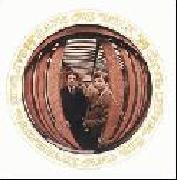
Review Summary: Long Island post-hardcore outfit utilizes electronics and gradually-built sonic climaxes to craft an innovative, expressive album despite a few DIY engineering issues.
Things to remember: the worth of character, the influence of example, the joy of origination, the dignity of simplicity, and the success of perseverance.
The struggle to express one's individuality in the real world can be a burdensome task. Stepping out of the shadow of an older sibling, or a parent, or having the resolve to finally break away from a homogeneous crowd can be a daunting task, particularly when receiving little-to-no support. Similarly, the expectation to conform to a certain standard or principle is equally troublesome in the conquest to highlight one's own originality. You can probably see where this is going: there really is no Point A to Point B to Point C blueprint a band has to follow in order to make it or break it in the industry. In the United States, certain geographical areas are synonymous with a particular genre, be it the Midwest and hip-hop or Norcal math rock (as some of my colleagues have postulated in previous articles and reviews), but there's also the argument that certain genres are oversaturated with carbon-copy, paint-by-numbers artists with any distinct trace of idiosyncrasy. How many bands exist in the industry today that emulate the quintessential [insert genre here] prototype only to do nothing to it at all? Why cover a song or play within the descriptors of a certain genre if there's a refusal to put your own flair to it?
For one case study in particular to narrow our focus, look no further than Long Island, home of post-hardcore quintet Disarming Arctica. Pop quiz: which celebrated artist(s) of this genre hails from this area? (a)
Glassjaw, (b)
Taking Back Sunday, (c)
Brand New, (d) all of the above. Hint: pick (d), with the understanding that, for every
Glassjaw, there's a
From Autumn to Ashes. While 'staying power' is crucial for the longevity of a genre, as all three of the previous are far-removed from life support, ingenuity is just as vital to increase listenership to a genre fraternity, and with their introductory EP
We're Always Watching You, Disarming Arctica's fusion of multiple genres leads to a diverse and satisfying listen that still has a distinct "room-to-grow" feel. With this five-piece, their own creativity and perseverance - as well as following in the footsteps of their influences who led by example - have crafted a very good, albeit slightly flawed, record.
Six songs deep,
We're Always Watching You integrates ambient electronics (envision a lite-version of Thrice's "Water" from the first half of their
Alchemy Index), straight-forward rock-and-roll construction, and ever-shifting structural changes that rarely lose sight of melody and texture. Beginning with "Marie Antoinette," the EP starts with scattered electronics before ripping into a heavy instrumental outpouring. It's an explosive intro, hindered slightly by vocalist Michael Assip's monotone shouts that lack any initial emotion and energy but gradually take on a powerful personality as his range increases during one of the many tempo/breakdown changes that divide the album opener. "Marie Antoinette's" biggest highlight is in its last minute, where Assip shouts between both channels: "Here is your song, we both hate each verse / I swear on this town that your smile's a curse / I won't let you down, if you wear this crown / Darling, can you feel me now?" The galloping outro, rife with snare rolls and chugging guitars, is an astounding and effective conclusion to make up for the sterile opening minutes.
Most post-hardcore bands who operate out of the DIY aesthetic tend to mix their albums poorly, with the rhythm section stationed too far in the mix or the drum kit levels being uneven. While Disarming Arctica don't quite buck this so-called engineering trend - there are a number of mixing issues with the vocals that leave portions of the lyrics cropped or pushed too far in the mix to be replaced by the next line - the band does an outstanding job manipulating its rhythm section.
We're Always Watching You's drums and bass have a very prominent role in the band's output, as evidenced by the cathartic "The Great Northern," which sports stunning guitar interplay between Adam Hecht and Thomas Colello, but is truly driven by bassist Ken Pryor and drummer Josh Hecht combining to create an intense backbone for the two guitarists to dive in and out of each channel with swift guitar leads and thick, crunching riffs. Pryor's bass is a highlight - especially in the intro and chorus alongside Josh's tight execution on the toms and cymbals - and probably would have served as a more convincing album opener on the record. The lone gripe about "The Great Northern" - which will become a recurring theme throughout
We're Always Watching You - is the insufficient vocal mixing. While the dual-channel vocal offerings are without question an important element to Disarming Arctica's delivery, Assip's vocals are cut off by his next line way too often, and his inflection isn't strong enough to sustain the line before it, causing a confusing, muddled delivery where words are lost.
For an instrumental segue, "Surveillance" is a top-of-the-line electronic cut and a clear album highlight, sporting rapid-fire snare and a bruising main "riff" similar to
65daysofstatic that are punctuated by heavily-distorted guitars and other soaring electronics. Despite the drop in tempo, the energy and passion are continued in "Motives," with Assip's fleshy "Stop, there's been an accident tonight - oh, what's been done?" soon giving way to an agitated "It doesn't matter what you've done - they're always watching you - we can live life on the run . . . heart's spinning black and blue, do you think we'll make it through?" Again, Disarming Arctica's musicianship shines through, elevating Assip's higher-range vocals via a punishing low-end dominated by an aggressive guitar riff. "So tell me you didn't know, since tomorrow is the show!" sings Assip in one of his best clean vocal features while a subtle electronic passage plays behind the final riff.
"Wake Up Now" is aptly named after the more moderately-paced "Motives," with frenetic electronics and a bellicose, powerful vocal and instrumental eruption, capped off with an effect-laden hammer-on/pull off solo and a near-metalcore breakdown with gang vocals and a loud, double-bass-heavy rumble. As a closer, "The Signal" serves as an efficient, serviceable conclusion, this time effectively incorporating both channels vocally so that Assip isn't lost in his own stylings. It's also another very effect-heavy guitar track, as if a delay and octave pedal were combined to make the high shriek that comes wailing out of the guitars. The argument could be made that either an E-bow or extremely fast tremolo picking was used in the bridge, reminiscent of
Hopesfall during the
Magnetic North sessions. In truth, "The Signal" is extremely reminiscent to the aforementioned Charlotte act.
Even with its flaws,
We're Always Watching You is an uncompromising record that effectively sets the stage for Disarming Arctica to pursue a full-length LP. While a lot of production and mixing kinks need to be ironed out - the lack of attention the dual-channel vocals were paid is unsettling - as were the uneven levels of the lead versus rhythm guitars. It's probably unfair to diagnose the problem - perhaps this was an intentional maneuver by the band - but the Swiss cheese delivery is comparable to reading a Choose-Your-Adventure book page-by-page instead of jumping to where you need to go. Yeah, you're going somewhere, but you're cutting yourself off from where you actually need to go. Aside from the unfortunate engineering issues and initial monotone vocals, the band appears to genuinely have a unique and innovative take on post-hardcore with their electronic passages - I am still very impressed by "Surveillance" and the more subtle electronic nuances in "Motives" - and the execution sonically is well above-average. All told, an auspicious EP that, with some expert seasoning, could be a welcome addition to any alterna-rock/post-hardcore fan's library.
B-
Jom recommends:
Surveillance -> Motives
The Great Northern
Wake Up Now
The Signal