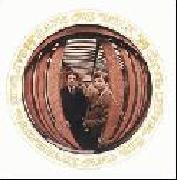
Review Summary: Expansive, ambitious, quite pretty, and utterly ruined by a hopelessly incompetent singer.
Perhaps the most consistent failing in the history of popular music, amongst rock artists in particular, is a lack of humour and wit. Altogether too many bands, young ones especially, take themselves painfully seriously, believing that every word and every note of their music will be held up to scrutiny by their listeners, and that any criticism of their music represents an unacceptable personal attack on everything they stand for. In that respect, the ever-mounting hype surrounding Glasvegas is justified - in 2008, nobody takes themselves as seriously as these guys (and girl) do.
Hailing from Glasgow, Glasvegas' sound owes more to the other part of their name. That's not to say it's glitzy, glammy, and throwaway (although there is something of that about the production at times), but more that it's big. Seriously big. Drums reverb for what seems an eternity, the guitars sound like they've been put through three or four delay units; spiritually, at least, this music has more in common with Sigur Ros than any of the expected reference points for a Scottish band (Orange Juice, Teenage Fanclub, Belle & Sebastian, etc.). That's one thing you can't take away from Glasvegas - they don't sound anything like their contemporaries. The best comparison is probably The Jesus & Mary Chain, given their simplistic drumming and love for Phil Spector-esque melodies, but even then one must acknowledge that they don't sound like any other J&MC inspired bands of this decade. Certainly not any British or successful ones, at any rate.
So it's no wonder they've been hyped. And what hype! A brief browse of the fourth estate during the month this was released revealed that no less than four major music publications, and three further newspapers, felt the need to mention
Definitely Maybe in their reviews of this album. That's pretty lofty praise. It's also confusing - the reason Oasis were such a big deal was that they presided over a period of music so starved of English guitars that Primal Scream's "Rocks" basically caused a mass orgasm when it made the UK Top 10. Obviously, things are different now, what with a good proportion of the most successful pop bands using plenty of guitars themselves, and it's hard to make out what, if anything, Glasvegas are meant to be standing for or reviving. Other than the art of being po-faced.
It's the vocals that are the main problem. The singer, James Allan, is just about the most utterly humourless man in music; the only way he could have come off worse during his appearance on pop quiz show Never Mind The Buzzcocks is if he'd stabbed a member of the audience. As a performer that comes through, in that he's a singer who belongs to two very serious and stern traditions, and as such sounds like a mutant hybrid of Ian Curtis and Roddy Woomble. He sings every word as if it's the most important thing anybody has ever said, and he also makes absolutely no effort to mask his broad Glaswegian accent. At times it's like listening to a political sermon being delivered by The Proclaimers. And how, ultimately, can a listener be expected to take that seriously? On one particularly cringeworthy track, he sings the words 'My name is Geraldine/I'm your social worker' as if he is bestowing holy knowledge. How can you not laugh at that? In truth, you actually find yourself feeling so sorry for him. Despite his sometimes impressive lyricism, 'rock star' is so obviously not his life's calling that it gets slightly embarrassing listening to him try.
There's a long-standing joke in England that observes how our print media refers to people like Andy Murray, Travis, David Coulthard, and Billy Connoley as 'British' when they're popular and successful, and 'Scottish' when they're not. By that logic, Glasvegas would still be considered Scottish on this showing. And yet, musically, this is a very good record, one that might have been worth as much as a 4.5 with a different vocalist. That's why it's still a worthwhile listen. No doubt there'll be a few very, very good bands inspired by these songs who will emerge over the next five years. When that happens,
Glasvegas will be rendered largely redundant. Until then, we shall have to listen to this, acknowledge how fresh and interesting it is at its best, and wish the singer had lightened up a bit.